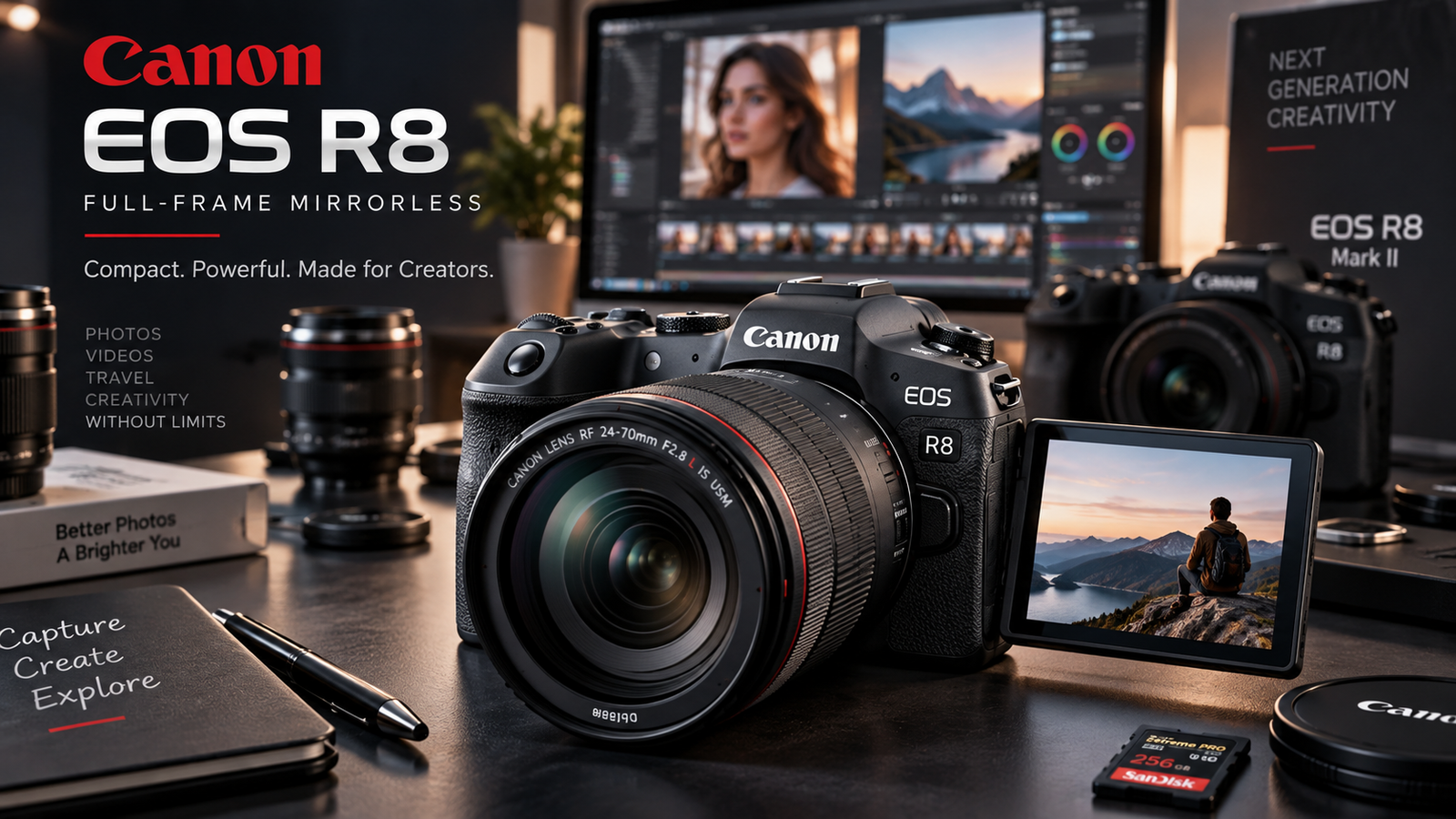
Canon EOS R8 gets a major 2026 buying boost as the R8 Mark II arrives. Check its price, specs, 4K video, 40fps shooting and latest firmware.
Household Electric Fan: The Quiet Shift to BLDC Cooling
The Canon EOS R8 has suddenly become a more interesting camera in 2026, not because Canon has quietly replaced it, but because the arrival of its successor has changed where the original model sits in the market.
Canon officially unveiled the EOS R8 Mark II on September 15, 2026. The new camera adds in-body image stabilization, a multi-controller joystick and other refinements while retaining the 24.2-megapixel full-frame sensor concept of the original R8. Importantly, Canon is continuing to position the original EOS R8 as a lower-priced option.
That makes the original Canon EOS R8 worth another look, particularly for photographers and creators who want a lightweight full-frame camera without moving into Canon’s more expensive R6-series territory.
Canon EOS R8 price in India
The current Canon India online listing shows the EOS R8 body at an MRP of ₹1,42,995, while Canon’s own online store was recently listing the body at ₹1,14,990, representing a ₹28,005 reduction from the listed MRP. Prices can change, so buyers should check the current Canon India store price before purchasing.
This pricing shift is particularly important following the launch of the EOS R8 Mark II.
The new generation carries a substantially higher launch price. Canon announced a US body-only estimated retail price of $1,899 for the R8 Mark II, compared with the original R8’s considerably lower current positioning.
For Indian buyers, the original R8 therefore occupies an interesting space: it delivers a full-frame sensor, fast electronic shooting and strong video capabilities while avoiding the higher entry price of the new generation.
What makes the Canon EOS R8 still relevant?
The EOS R8 was designed around a simple idea: put a full-frame sensor and sophisticated autofocus into a remarkably lightweight body.
Canon lists the camera at approximately 461 grams including the battery and memory card. It uses a 24.2-megapixel full-frame CMOS sensor and DIGIC X processor, with Canon’s Dual Pixel CMOS AF II autofocus system.
The camera can shoot at up to 40 frames per second using its electronic shutter, which remains an impressive specification for a relatively compact full-frame body. Electronic first-curtain shooting is available at up to 6fps.
That combination makes the R8 suitable for travel photography, portraits, family photography, street work and situations where a photographer needs fast autofocus and burst shooting without carrying a larger professional body.
The big limitation: no built-in image stabilization
There is one specification that becomes much more noticeable now that the R8 Mark II has arrived: the original R8 does not have sensor-shift in-body image stabilization.
Canon’s specifications explicitly list the EOS R8 as having no in-body image stabilization. Optical stabilization can instead come from compatible RF lenses, while Movie Digital IS provides electronic stabilization for video.
The R8 Mark II addresses this weakness with five-axis IBIS rated by Canon at up to 7.5 stops at the centre under specified conditions.
For photographers who regularly shoot handheld in low light, this is an important distinction between the two generations.
For someone who primarily uses stabilized RF lenses, shoots at faster shutter speeds or photographs in good light, the absence of IBIS may be less significant.
A strong full-frame camera for video creators
Video is another area where the Canon EOS R8 remains competitive.
Canon’s Indian product specifications list 4K 60p video with 6K oversampling, Full HD recording at up to 180p and Canon Log 3 for greater flexibility during post-production.
The camera also includes microphone and headphone connections, USB-C connectivity and a fully articulating touchscreen. Those features make it useful for vloggers, interview creators and photographers who want to add serious video capability without moving to a dedicated cinema camera.
The combination of a full-frame sensor and Canon Log 3 is particularly relevant for creators who want more control over the final appearance of their footage.
Autofocus remains one of the R8’s biggest strengths
The EOS R8 uses Canon’s Dual Pixel CMOS AF II system and supports subject detection for people, animals and vehicles.
Canon specifies autofocus coverage across essentially the full image area when Face Detect + Tracking AF is used, with up to 1,053 AF zones.
In practical shooting, this means the camera is designed to keep subjects tracked rather than requiring the photographer to constantly reposition a single focus point.
That is particularly useful for family photography, pets, sports and casual action photography.
The EOS R8 versus the new R8 Mark II
The arrival of the Mark II changes the buying conversation, but it does not automatically make the original camera irrelevant.
The EOS R8 Mark II keeps the 24.2MP full-frame sensor concept but adds five-axis IBIS, a new multi-controller joystick, enhanced autofocus capabilities and up to 40fps electronic shooting. Canon also adds uncropped 4K 60p oversampled from 6K and Full HD recording up to 180p.
The new camera weighs approximately 546 grams with battery and card, making the original R8 lighter by roughly 85 grams.
That difference may matter to travel photographers who prioritize a small kit.
The bigger difference, however, is price.
The R8 Mark II is entering the market at a significantly higher price, while Canon continues selling the original R8 as a more affordable full-frame option.
Canon EOS R8 firmware update
Canon has also continued supporting the original R8 through firmware updates.
Firmware version 1.6.0 was released in May 2026. Canon says the update improves operational stability and fixes an issue that could prevent the camera from being recognized when connected to a smartphone through USB.
Owners should check the firmware version installed on their camera and use Canon’s regional support page for the appropriate update procedure.
Firmware updates do not transform the R8 into a newer-generation camera, but they can address operational problems and maintain compatibility.
Who should consider the Canon EOS R8 now?
The EOS R8 makes particular sense for someone moving from an APS-C Canon camera into full frame and looking for a relatively lightweight body.
It is also relevant for creators who want strong video specifications, fast autofocus and a high-speed electronic shutter without paying for a more expensive professional body.
Travel photographers may appreciate its 461-gram body, while portrait photographers can take advantage of the full-frame sensor and RF lens ecosystem.
The main question is whether the savings compared with the R8 Mark II are large enough for the buyer to accept the lack of IBIS and the older control layout.
That decision will depend heavily on the actual selling price at the time of purchase.
The 2026 buying picture
The Canon EOS R8 now sits in an unusual but potentially attractive position.
The R8 Mark II brings the features many users wanted from the original camera, especially IBIS and improved physical controls. But those upgrades also come with a substantially higher price.
Meanwhile, the original EOS R8 retains its 24.2MP full-frame sensor, 40fps electronic shooting, Dual Pixel CMOS AF II, 4K 60p video and Canon Log 3.
With Canon India’s current online price substantially below the listed MRP, the original model has become particularly relevant for buyers who prioritize value and portability.
The important point is that the R8 is no longer simply an older Canon full-frame camera competing with other models. It is now the lower-cost member of a two-generation R8 family.
For photographers who do not need IBIS, the new joystick or the latest autofocus refinements, that distinction could make the original Canon EOS R8 an interesting full-frame option in 2026.
Canon EOS R8
Canon introduced the EOS R8 as a compact full-frame mirrorless camera aimed at creators and enthusiasts. Its combination of a 24.2MP full-frame sensor, DIGIC X processor, advanced autofocus, 40fps electronic shooting and 4K 60p video gave it a specification set that extended beyond what its relatively lightweight body might suggest.
The September 2026 launch of the EOS R8 Mark II has now created a clearer separation between the two generations. The Mark II adds IBIS and additional controls while retaining the same 24.2MP resolution class. Canon’s decision to keep the original R8 available as a lower-cost model gives consumers two different approaches to the same compact full-frame concept.
Frequently asked questions
Is the Canon EOS R8 still worth buying in 2026?
It can be, particularly if the lower price is more important to you than IBIS and the newer controls introduced with the R8 Mark II.
Does the Canon EOS R8 have IBIS?
No. The original EOS R8 does not have sensor-shift in-body image stabilization. Compatible lenses can provide optical stabilization.
How many megapixels does the Canon EOS R8 have?
The EOS R8 has a 24.2-megapixel full-frame CMOS sensor.
Can the Canon EOS R8 shoot 4K 60p?
Yes. Canon lists 4K 60p recording with 6K oversampling, along with Full HD recording up to 180p.
Can the Canon EOS R8 shoot at 40fps?
Yes. Its electronic shutter supports continuous shooting at up to 40 frames per second.
What is the latest Canon EOS R8 firmware?
Canon’s current published firmware notice identifies version 1.6.0, which includes operational stability improvements and a fix for a USB smartphone-recognition issue.
Disclaimer: This article is intended for informational and editorial purposes only. Canon, EOS, EOS R8, and related trademarks, logos, product names, and intellectual property belong to their respective owners. Product specifications, pricing, availability, firmware information, and features may change without prior notice. Readers should verify the latest details through Canon’s official website and authorized retailers before making a purchase. This website is not affiliated with, sponsored by, or endorsed by Canon unless explicitly stated.
Canon EOS R8 Captures Global Attention in 2026

Canon EOS R8 gets a major 2026 buying boost as the R8 Mark II arrives. Check its price, specs, 4K video, 40fps shooting and latest firmware. Household Electric Fan: The Quiet Shift to BLDC Cooling The Canon EOS R8 has suddenly become a more interesting camera in 2026, not because Canon has quietly replaced it,…
Household Electric Fan: The Quiet Shift to BLDC Cooling

A household electric fan is getting smarter in 2026, with BLDC motors, battery backup and better efficiency reshaping how Indian homes stay cool. Redmi Note 17 Pro Max: 10,000mAh Battery Changes Game Household Electric Fan: The Quiet Shift to BLDC Cooling The humble household electric fan is going through a surprisingly important transformation. For decades,…
Redmi Note 17 Pro Max: 10,000mAh Battery Changes Game
Redmi Note 17 Pro Max brings a 10,000mAh battery, 100W charging, 120Hz AMOLED and Snapdragon 6 Gen 5. India launch is tipped for September 15, 2026 Price is key Lattice-Based Cryptography: The Quantum-Safe Race Xiaomi Redmi Note 17 Pro Max is now official, but India is the real test The xiaomi redmi note 17 pro…