
3D printing is transforming industries with AI integration, advanced materials, large-scale production. Explore the latest news, trends, and future innovations.
Social Networking 2026: AI Feeds, Trust Crisis & the Evolution of Digital Communities
Introduction: 3D Printing Enters the Industrial Core
3D printing—also known as additive manufacturing—is no longer limited to prototypes and hobbyists. In 2026, it is evolving into a full-scale manufacturing technology, powered by AI, advanced materials, and automation.
From construction to aerospace, 3D printing is becoming a strategic technology reshaping how products are designed, produced, and distributed.
Latest News Highlights (2026)
Multi-Nozzle 3D Printers Push Speed & Complexity
A new generation of 3D printers with up to 12 nozzles is enabling multi-material and multi-color printing at high speed, reducing production time and waste.
3D-Printed Construction Gains Momentum
Large-scale 3D printing is now being used to build houses in nearly half the time of traditional methods, showcasing its potential in solving housing and infrastructure challenges.
Industrial Metal 3D Printing Expands
Companies are scaling production of large metal components for defense and energy sectors, highlighting industrial adoption of additive manufacturing.
Security & Regulation Challenges Emerge
Governments are exploring ways to regulate 3D printing due to risks like untraceable weapon production, emphasizing the need for secure design control systems.
Consumer-Level Customization Breakthroughs
New technologies allow users to print or modify designs on everyday objects like clothing using light-based systems, bringing mass personalization to consumers.
What Is 3D Printing?
3D printing is a manufacturing process that creates objects layer by layer using digital design files. Unlike traditional subtractive manufacturing, it minimizes waste and enables complex geometries that were previously impossible.
It is widely used in:
- Aerospace and defense
- Healthcare and bioprinting
- Automotive and industrial manufacturing
- Consumer goods and fashion
Key Technology Trends in 3D Printing (2026)
AI-Powered Design & Automation
AI is transforming 3D printing by automating:
- Model generation
- Structural optimization
- Print path efficiency
This reduces the need for manual design expertise and accelerates production cycles.
Shift from Prototyping to Production
3D printing is moving beyond prototyping into mass production, enabling companies to manufacture end-use parts at scale.
Advanced Materials Revolution
Breakthroughs include:
- High-performance metals
- Composite materials
- Bioprinting tissues
New techniques now allow printing of extremely hard materials with reduced waste, improving efficiency and durability.
Multi-Material & Functional Printing
New platforms can print fully functional devices (like electric motors) using multiple materials in a single process, reducing assembly requirements.
Sustainable & On-Demand Manufacturing
3D printing supports:
- Reduced material waste
- Localized production
- Lower supply chain dependency
This aligns with global sustainability goals and circular economy models.
Industry 4.0 Integration
Modern 3D printers are integrated with:
- IoT sensors
- Real-time monitoring systems
- Automated quality control
This enables smart factories and fully digital manufacturing ecosystems.
Emerging Applications of 3D Printing
Healthcare & Bioprinting
- Custom implants and prosthetics
- Tissue engineering and organ research
Aerospace & Defense
- Lightweight components
- Complex geometries for high-performance systems
Construction & Infrastructure
- 3D-printed buildings
- Rapid urban development solutions
Consumer Customization
- Personalized products
- On-demand manufacturing at home
Technical Challenges
Intellectual Property Risks
Design files can be copied or stolen, raising concerns about digital security.
Material Limitations
Not all materials are suitable for additive manufacturing at scale.
Process Reliability
Ensuring consistent quality across large-scale production remains a challenge.
Regulatory Uncertainty
Governments are still developing frameworks to regulate emerging applications.
Future Outlook: What’s Next for 3D Printing?
The future of 3D printing will be defined by:
Fully Autonomous Manufacturing
AI-driven systems capable of designing and producing objects without human intervention.
Distributed Production Networks
Localized manufacturing hubs replacing global supply chains.
Bioprinting Breakthroughs
Potential for printing functional human tissues and organs.
Mass Customization at Scale
Consumers will be able to order fully personalized products produced instantly.
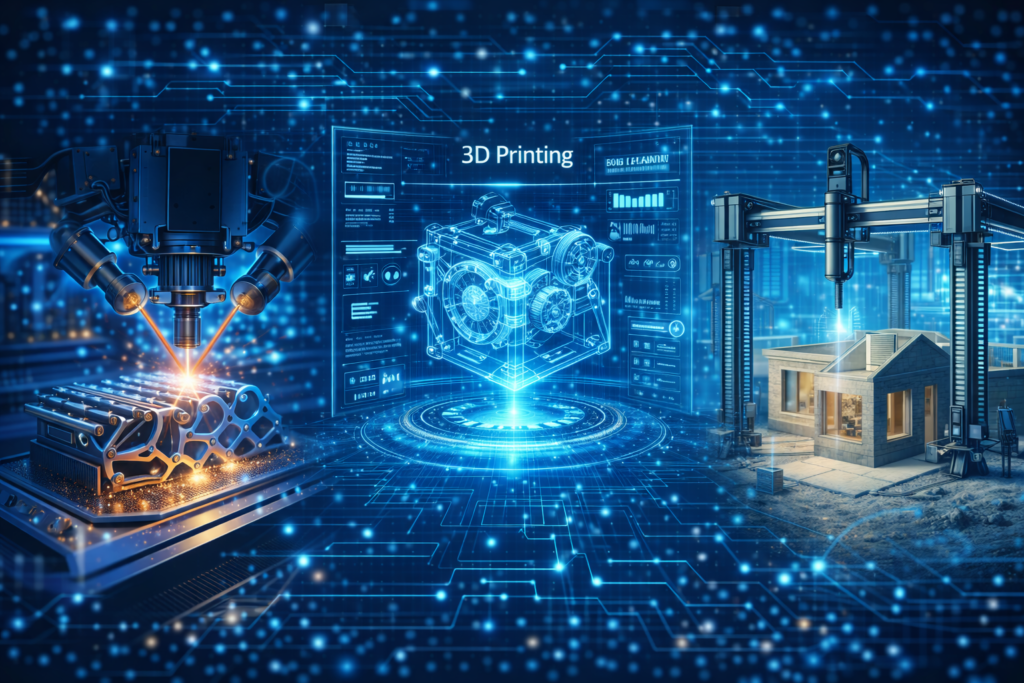
Disclaimer: This image is an AI-generated conceptual illustration created for informational and creative purposes only. It does not depict any real 3D printing system, industrial setup, or construction project. The visuals—including industrial printers, holographic interfaces, and construction-scale printing—are symbolic representations of current trends and future possibilities in 3D printing technology. Any resemblance to actual machines, companies, or real-world implementations is purely coincidental.
One UI 9: Samsung’s Android 17 Update Rolls Out

One UI 9 is rolling out with Android 17, Galaxy AI upgrades, privacy tools and new features. Here’s the latest Samsung rollout news and device status. Canon EOS R8 Captures Global Attention in 2026 One UI 9: Samsung’s Android 17 Rollout Gathers Pace Samsung’s One UI 9 rollout is entering an important phase. After months…
Canon EOS R8 Captures Global Attention in 2026

Canon EOS R8 gets a major 2026 buying boost as the R8 Mark II arrives. Check its price, specs, 4K video, 40fps shooting and latest firmware. Household Electric Fan: The Quiet Shift to BLDC Cooling The Canon EOS R8 has suddenly become a more interesting camera in 2026, not because Canon has quietly replaced it,…
Household Electric Fan: The Quiet Shift to BLDC Cooling
A household electric fan is getting smarter in 2026, with BLDC motors, battery backup and better efficiency reshaping how Indian homes stay cool. Redmi Note 17 Pro Max: 10,000mAh Battery Changes Game Household Electric Fan: The Quiet Shift to BLDC Cooling The humble household electric fan is going through a surprisingly important transformation. For decades,…





Pingback: 🎬 Video Streaming 2026: AI Personalization, Market Saturation & the Battle for Viewer Attention