
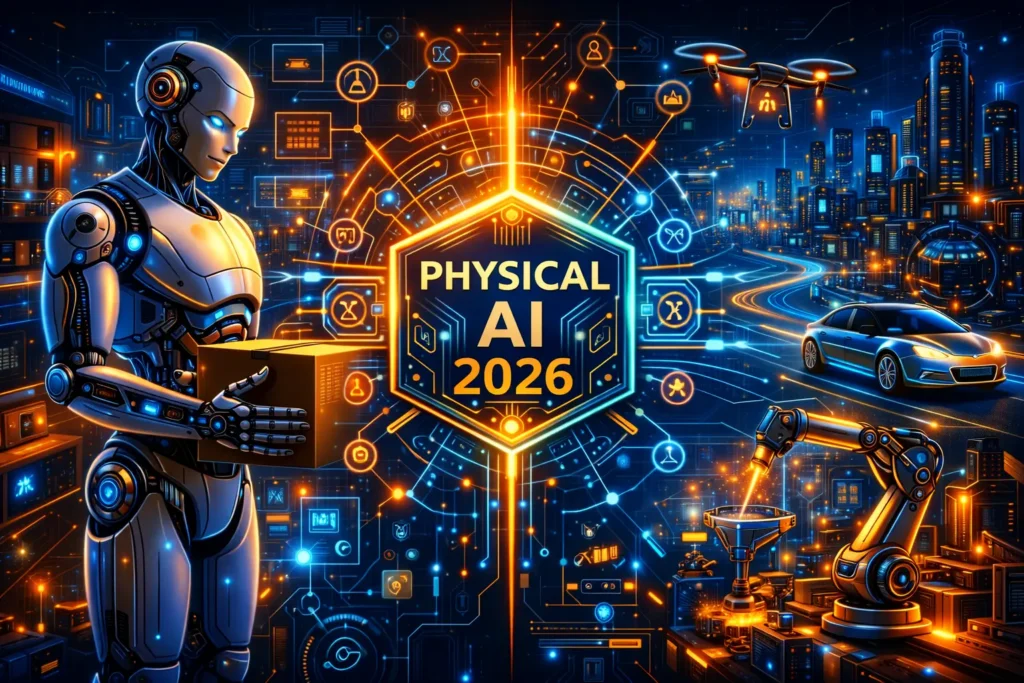
Physical AI is revolutionizing 2026 by enabling machines to interact with the real world through robotics, sensors, and autonomous decision-making systems.
Domain-Specific Language Models Transform AI in 2026
The Rise of Physical AI
The AI revolution is no longer confined to screens and software. In 2026, Physical AI is emerging as the next major breakthrough—bringing intelligence into the real world through robots, autonomous systems, and smart devices.
From factories to homes, Physical AI is enabling machines to see, move, adapt, and make decisions in real environments, marking a shift from digital intelligence to embodied intelligence.
Latest News Shaping Physical AI (2026)
- Organizations are increasingly experimenting with Physical AI, with adoption accelerating due to cheaper hardware, better sensors, and simulation-driven training.
- Tech giants are investing heavily in AI-powered hardware ecosystems, signaling a race to build real-world intelligent devices.
- Chipmakers and robotics companies are forming dedicated Physical AI divisions, highlighting long-term strategic importance.
- Manufacturing is undergoing transformation through AI-driven automation, predictive maintenance, and digital twin technologies.
- Industry leaders describe this moment as a “ChatGPT moment for Physical AI”, marking a turning point for real-world AI adoption.
From Digital AI to Physical Intelligence
For years, AI has focused on:
- Text (chatbots, LLMs)
- Images (computer vision)
- Data analytics
Now, Physical AI extends intelligence into the physical world by integrating:
- Sensors (vision, motion, sound)
- Robotics and actuators
- Real-time decision-making systems
This shift allows machines to interact with their environment dynamically, rather than simply analyzing data.
What Is Physical AI?
Physical AI refers to AI systems embedded in physical machines that can:
- Perceive real-world environments
- Make decisions based on sensory input
- Act autonomously through mechanical systems
Examples include:
- Autonomous robots in warehouses
- Self-driving vehicles
- Smart industrial machines
- AI-powered wearables and devices
Unlike traditional AI, Physical AI focuses on real-world execution, not just prediction.
Key Trends Driving Physical AI in 2026
Robotics Breakthroughs
AI is enabling robots to learn movements, adapt to environments, and recover from damage, making them more resilient and useful.
Simulation & Digital Twin Training
Before deployment, AI systems are trained in virtual environments, improving safety, efficiency, and scalability.
Edge AI & Real-Time Processing
Physical AI relies on on-device computation, reducing latency and enabling instant decision-making.
AI + Hardware Convergence
Companies are building integrated stacks combining chips, sensors, and AI models, accelerating deployment across industries.
Autonomous Industrial Systems
Warehouses, factories, and logistics systems are adopting Physical AI for automation and operational efficiency.
Enterprise Impact: Why Physical AI Matters
Organizations adopting Physical AI gain:
- Automation of physical tasks
- Increased productivity and efficiency
- Reduced human labor in hazardous environments
- Real-time decision-making capabilities
Key industries:
- Manufacturing (robotic automation)
- Logistics (autonomous warehouses)
- Healthcare (surgical robots)
- Automotive (self-driving vehicles)
Physical AI is effectively transforming industries into intelligent, autonomous ecosystems.
Challenges & Risks
Despite rapid growth, Physical AI faces challenges:
- Safety and reliability concerns
- High hardware and deployment costs
- Complex integration with real-world environments
- Ethical and regulatory issues
Experts emphasize the need for strong governance, testing frameworks, and human oversight.
Future Outlook: The Age of Embodied Intelligence
The future of Physical AI includes:
- Humanoid robots working alongside humans
- Autonomous vehicles and smart cities
- AI-powered personal devices and wearables
- Fully automated industrial ecosystems
Analysts predict that Physical AI will become a multi-trillion-dollar market, driven by robotics, automation, and intelligent infrastructure.
Disclaimer : The information provided in this article is for informational and educational purposes only. While every effort has been made to ensure accuracy, completeness, and relevance, the rapidly evolving nature of Physical AI and related technologies means that updates, innovations, and regulatory changes may occur without prior notice. This content does not constitute professional, technical, financial, legal, or investment advice. Readers are encouraged to conduct independent research and consult qualified professionals before making decisions related to AI adoption, automation strategies, or business investments. The author and publisher disclaim any liability for any direct or indirect losses, damages, or consequences arising from the use of or reliance on the information presented. All trademarks, product names, and company names mentioned are the property of their respective owners.
One UI 9: Samsung’s Android 17 Update Rolls Out

One UI 9 is rolling out with Android 17, Galaxy AI upgrades, privacy tools and new features. Here’s the latest Samsung rollout news and device status. Canon EOS R8 Captures Global Attention in 2026 One UI 9: Samsung’s Android 17 Rollout Gathers Pace Samsung’s One UI 9 rollout is entering an important phase. After months…
Canon EOS R8 Captures Global Attention in 2026

Canon EOS R8 gets a major 2026 buying boost as the R8 Mark II arrives. Check its price, specs, 4K video, 40fps shooting and latest firmware. Household Electric Fan: The Quiet Shift to BLDC Cooling The Canon EOS R8 has suddenly become a more interesting camera in 2026, not because Canon has quietly replaced it,…
Household Electric Fan: The Quiet Shift to BLDC Cooling
A household electric fan is getting smarter in 2026, with BLDC motors, battery backup and better efficiency reshaping how Indian homes stay cool. Redmi Note 17 Pro Max: 10,000mAh Battery Changes Game Household Electric Fan: The Quiet Shift to BLDC Cooling The humble household electric fan is going through a surprisingly important transformation. For decades,…



Pingback: Preemptive Cybersecurity 2026: Stop Threats Before They Strike