
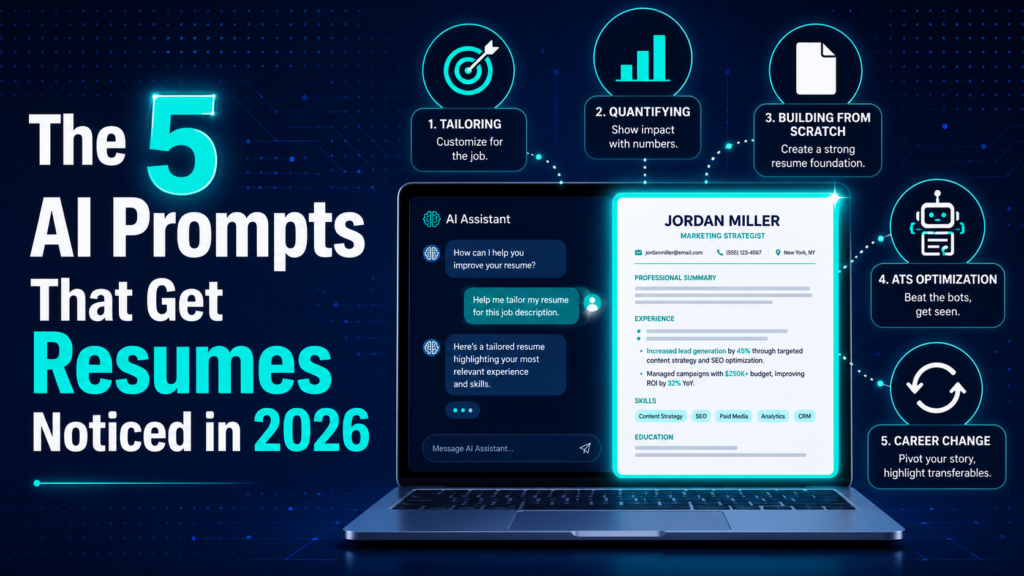
Discover the top 5 AI prompts for resume building in 2026. Learn how to use ChatGPT, Claude & Gemini to craft ATS-optimized, interview-winning resumes fast.
The global job market shifted dramatically in 2025 and continues to evolve in 2026. Applicant Tracking Systems (ATS) now pre-screen the overwhelming majority of resumes before any recruiter ever lays eyes on them. According to data from Jobscan’s 2025 State of the Job Search Report, most resumes are eliminated at this automated stage — not because the candidate is unqualified, but because the document fails to speak the language the software understands. Into this environment stepped AI, and with it, a new discipline: prompt engineering for career documents. Tools like ChatGPT, Claude, and Gemini have become legitimate co-writers in the job search process, but only when the person using them knows how to direct them with clarity and purpose.
There is a version of resume writing that most people still live inside — the one where you stare at a blank document for two hours, copy a bullet point from your last job description, tweak a few words, and hope that what lands on a recruiter’s desk is good enough. That version is quickly becoming obsolete, and not because AI is doing the work for you. It is becoming obsolete because AI, when properly directed, helps you say the right things in the right language to both the bots and the humans who decide whether you get an interview.
The key phrase there is “properly directed.” Sitting down with ChatGPT or Claude and typing “help me fix my resume” is roughly as useful as calling a professional resume writer and telling them you want something that “looks good.” The output will be polished, generic, and completely forgettable. What separates the job seekers who are landing interviews in 2026 from those who are watching their applications disappear into the void is not access to AI — everyone has that. It is the quality of their prompts for resume building.
Here are the five prompts that career coaches, recruiters, and job seekers are using right now to produce resumes that actually work.
Microsoft Copilot 2026 AI Agents, Adoption & Strategy Shift
The Prompt That Tailors Your Resume to a Specific Job
Most job seekers send the same resume everywhere. Recruiters know this within three seconds of reading the document. The first and most impactful thing AI can do for your job search is solve this problem at scale — tailoring your resume to each role without requiring you to rewrite everything from scratch each time.
The prompt that does this well goes something like this: “I am applying for a [Job Title] role at [Company Name]. Here is my current resume: [paste resume]. Here is the job description: [paste JD]. Rewrite my resume to align with this specific role. Highlight relevant skills, reorder sections for maximum impact, integrate exact keywords from the job description naturally, and flag any gaps between my experience and their requirements.”
What makes this prompt work is that it gives the AI three things at once — your identity (the resume), the target (the job description), and a clear instruction set. The more detail you provide, the less the AI has to guess, and the less it guesses, the more specific and usable the output becomes. Always verify the output, though. AI tools occasionally introduce metrics or achievements that sound plausible but are not accurate to your actual history.
The Prompt That Turns Job Duties into Impact Statements
If you have spent any time around recruiters, you have heard the advice: quantify everything. The problem is that most professionals genuinely struggle to translate what they did at a job into the kind of achievement-forward language that stands out. They write things like “responsible for managing social media accounts” when what they actually mean is “grew Instagram engagement by 140% over six months by overhauling the content calendar.”
This is where AI earns its reputation as a resume writing tool. A strong prompt sounds like this: “Rewrite the following resume bullet points using the CAR framework — Challenge, Action, Result. For any bullet where I have not given you numbers or metrics, ask me three targeted questions to help me find and quantify the impact. Here are my current bullets: [paste bullets].”
The instruction to ask follow-up questions is critical. It keeps the AI honest and prevents it from inventing data. What you often discover through this process is that you have far more impressive numbers buried in your memory than you realized — percentage improvements, cost savings, team sizes managed, revenue influenced. The AI’s job here is to draw that out and shape it into language that commands attention.
The Prompt That Builds Your Resume from Raw Notes
Not everyone coming to AI-assisted resume writing has an existing document to work from. Career starters, people returning to work after a gap, or those who have spent years in roles where a resume was simply never needed often face the disorienting task of building from zero. This is actually one of the areas where AI performs most impressively, provided the prompt gives it enough raw material.
The prompt: “I want to build a professional resume from scratch. I will give you an unstructured summary of my work experience, education, skills, and career goals. Based on this, create a clean, reverse-chronological resume with a strong professional summary, tailored experience bullets, and relevant skills section. Here is my background: [paste your notes, even messy and informal ones].”
The insight behind this approach is that AI is exceptionally good at imposing structure on unstructured material. You do not need to have your experience already organized into tidy categories. You can write it out the way you would explain it to a friend over coffee, and the AI will find the professional frame within it. The important thing is to give it volume — the more context you pour in, the more it has to work with.
The Prompt That Optimizes Your Resume for ATS
Understanding how Applicant Tracking Systems work is no longer optional knowledge for job seekers. These systems scan resumes for specific keywords drawn from the job description, rank candidates based on how well their documents match, and filter out anyone below a certain threshold before a human ever gets involved. A resume that would impress any recruiter in a room can fail silently at this automated stage simply because it uses slightly different language than the posting.
AI can bridge this gap directly. The prompt: “Act as an Applicant Tracking System. Scan my resume below and extract the top 15 keywords and skills. Then compare them against the following job description and tell me which required keywords are missing entirely, which are underrepresented, and rewrite my experience section to naturally incorporate the gaps. Resume: [paste resume]. Job Description: [paste JD].”
This prompt reframes the AI as the system you are trying to beat, which forces it into a diagnostic mode rather than a generative one. The output is not a polished document — it is a gap analysis followed by targeted rewrites. That combination of diagnosis and correction is far more valuable than simply asking the AI to “make my resume better for ATS,” because it shows you exactly what is missing and why.
The Prompt That Repositions You for a Career Change
Career pivots are arguably the hardest resume challenge that exists. You have experience — sometimes decades of it — but it is in the wrong category on paper. The instinct many people have is to apologize for this in their resume, to bury the mismatch and hope no one notices. The better instinct, and the one AI can help you execute, is to reframe everything you have done as preparation for where you are going.
The prompt: “I am transitioning from [Current Role/Industry] to [Target Role/Industry]. Here is my current resume: [paste resume]. Rewrite it to lead with a strong professional summary that positions me as a compelling candidate for my target role. Identify and highlight transferable skills throughout the experience section, reframe past achievements in language relevant to my new field, and flag anything that should be downplayed or removed.”
The phrase “reframe past achievements in language relevant to my new field” is doing significant work in this prompt. It tells the AI not just to cut and rearrange, but to actually translate — to find the version of your marketing experience that reads as data analysis experience, or the version of your teaching background that reads as corporate training and development. That translation is where the magic of a career pivot resume happens, and it is genuinely difficult to do without an outside perspective, whether that comes from a human career coach or a well-directed AI tool.
How to Get the Most Out of Any Resume Prompt
The underlying principle across all five of these approaches is the same: specificity drives quality. Vague instructions produce vague resumes. When you treat AI the way you would treat a brilliant but entirely uninformed collaborator — someone who is capable of extraordinary work but knows nothing about you, your industry, or the job you want — you start to write better prompts naturally.
A few practices that make an immediate difference: always paste the actual job description rather than summarizing it, include any personal preferences about tone (formal, confident, not overly corporate), tell the AI what you do not want as explicitly as what you do, and iterate. The first draft is rarely the best one. Ask it to give you three versions, pick the elements that land, and ask it to go deeper on those.
It is also worth running the same prompt through two or three different AI tools — ChatGPT, Claude, and Gemini each have slightly different strengths in terms of tone and structure — and combining the best elements of each output. The resume you submit should ultimately sound like you at your most polished and articulate, not like a machine produced it. That final edit, where you restore your voice and verify every fact, is the step no AI can do for you — and the step that makes all the difference.
Disclaimer: The information provided in this article is intended for general informational and educational purposes only. The AI prompts for resume building shared here are based on publicly available practices, tools, and industry observations as of 2026, and results may vary depending on the individual, the role applied for, the industry, and the AI platform used.
The mention of any AI tools, platforms, or third-party services — including but not limited to ChatGPT, Claude, and Gemini — does not constitute an endorsement, sponsorship, or affiliation with their respective companies. All product names, logos, and brand names are the property of their respective owners.
While every effort has been made to ensure the accuracy and relevance of the content, we make no warranties or representations of any kind, express or implied, about the completeness, reliability, or suitability of the information for your specific situation. Using AI-generated content as part of your job application process is done entirely at your own discretion and risk.
Pingback: Kissflow 2026: AI Workflows Reshape Enterprise Automation