
N8N is rapidly transforming AI workflow automation in 2026 with agentic systems, self-hosted orchestration, and enterprise adoption.
HubSpot 2026: AI CRM Evolution Reshapes Marketing
N8N’s AI Automation
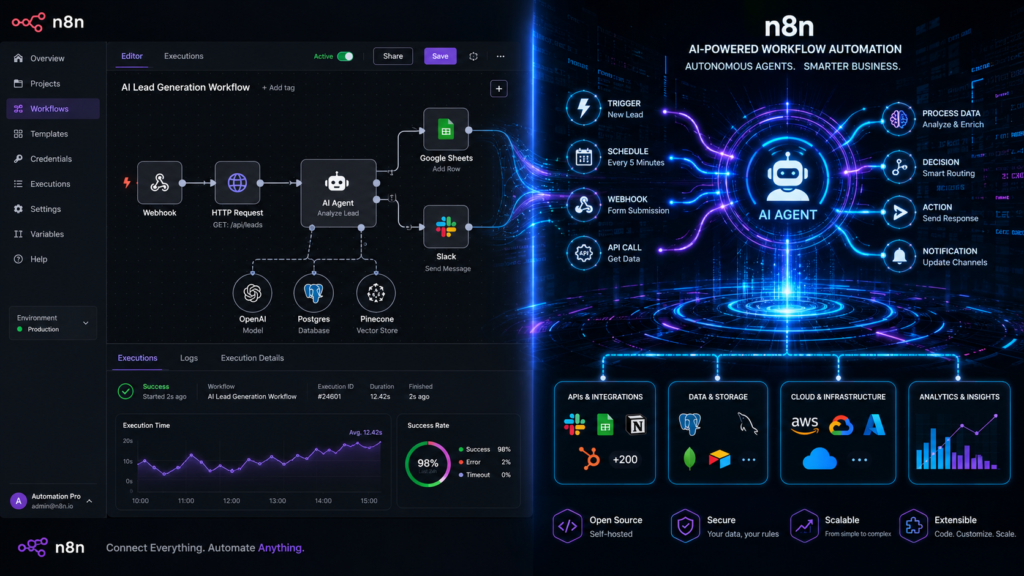
The rise of AI automation platforms has fundamentally changed how businesses operate in 2026, and few tools are attracting as much attention as n8n. Once viewed primarily as an open-source alternative to traditional workflow tools, N8N has evolved into one of the most influential platforms powering AI-driven orchestration, autonomous workflows, and low-code enterprise automation.
Over the past year, N8N has experienced explosive adoption among startups, developers, automation agencies, and enterprise operations teams seeking more control over AI integrations and workflow infrastructure. Unlike many SaaS-first automation platforms, N8N’s self-hosted architecture and developer-friendly customization capabilities have become major advantages in an era increasingly defined by privacy concerns, AI governance, and infrastructure ownership.
The latest developments surrounding N8N reveal how quickly the platform is moving beyond simple task automation. In 2026, much of the conversation around N8N revolves around AI agents, multi-model orchestration, human-in-the-loop workflows, and autonomous decision systems. The platform’s official engineering blog has increasingly focused on production-grade AI deployment, observability, evaluation systems, and workflow orchestration at scale.
One of the strongest drivers behind N8N’s growth is the global surge in demand for AI-powered business automation. Organizations are no longer satisfied with basic trigger-based workflows. They now want systems capable of understanding context, generating content, routing decisions dynamically, and integrating across multiple AI models simultaneously. N8N has positioned itself directly at the center of this transition.
The platform’s architecture appeals especially to technical teams because it combines visual workflow simplicity with code-level flexibility. Developers can integrate APIs, execute JavaScript or Python, deploy AI agents, and maintain infrastructure ownership without relying entirely on closed ecosystems. This balance between low-code accessibility and engineering-level extensibility is increasingly separating N8N from competitors in the automation market.
Recent industry comparisons have highlighted this distinction even more clearly. Analysts increasingly describe N8N as ideal for deterministic automation systems where organizations need reliability, auditability, and scalable orchestration. Emerging autonomous AI agents may handle ambiguous tasks independently, but many companies still prefer N8N for mission-critical operational workflows where predictable execution matters most.
The platform’s momentum is also visible across online developer communities. Reddit discussions and technical forums are filled with users sharing AI-powered N8N workflows that automate news summarization, customer support routing, sales qualification, database management, and marketing operations. One widely discussed workflow published recently combined RSS feeds, AI summarization, and automated email delivery into a fully autonomous business news briefing system.
Beyond startups and solo creators, enterprise interest in N8N continues accelerating. Many organizations now view workflow orchestration as a strategic infrastructure layer rather than a productivity convenience. As companies deploy multiple AI systems simultaneously, orchestration platforms like N8N are becoming critical coordination engines connecting databases, APIs, cloud services, LLMs, CRMs, and internal business tools.
Academic research is beginning to validate the efficiency gains associated with platforms like N8N. A 2026 case study analyzing small-scale workflow automation found dramatic reductions in operational execution time and manual error rates after implementing N8N-based automation systems. Researchers concluded that low-code orchestration tools are becoming increasingly viable for operational optimization across small and mid-sized organizations.
Another emerging area of interest involves reusable AI workflow construction. Researchers studying agentic AI systems recently used hundreds of real-world N8N workflows to test dynamic orchestration frameworks capable of automatically reconstructing enterprise automation pipelines with high accuracy. The findings suggest that N8N’s node-based architecture may become highly relevant for the next generation of modular AI systems.
At the same time, N8N’s rapid expansion has also drawn cybersecurity attention. Security researchers disclosed several vulnerabilities and supply-chain risks affecting parts of the broader N8N ecosystem earlier this year. Reports involving webhook abuse, credential theft attempts, and remote code execution vulnerabilities highlighted the growing importance of security governance as automation platforms become deeply embedded inside enterprise operations.
Despite those concerns, N8N’s overall trajectory remains exceptionally strong. The broader AI economy is increasingly shifting toward workflow-centric infrastructure where orchestration layers determine how data, models, APIs, and human oversight interact in production environments. N8N is benefiting directly from that structural shift.
The platform is also becoming increasingly influential within the AI creator economy. Automation consultants, AI agencies, and independent developers are building entire businesses around N8N-powered systems. YouTube tutorials, online bootcamps, and workflow marketplaces dedicated to N8N have grown rapidly throughout 2026, reflecting strong demand for practical automation skills.
What makes N8N particularly important in today’s market is not simply automation itself. It is the platform’s ability to act as connective infrastructure between AI models, human oversight, operational systems, and business logic. In many ways, N8N represents the operational backbone of the emerging AI-native workplace.
As enterprises continue searching for scalable ways to operationalize artificial intelligence, workflow orchestration is becoming less of a technical niche and more of a core business requirement. N8N’s continued growth suggests the company understands exactly where that transformation is heading.
N8N
n8n is an open-source workflow automation platform designed to connect applications, APIs, databases, and AI systems through node-based visual workflows. Originally popular among developers seeking a self-hosted alternative to SaaS automation platforms, N8N has expanded significantly due to growing demand for AI orchestration, low-code automation, and enterprise workflow control. The platform now supports hundreds of integrations alongside native AI workflow capabilities.
Disclaimer: This article is intended for informational, educational, and editorial purposes only. References to N8N, AI workflow automation, integrations, enterprise systems, and related technologies are based on publicly available industry reports, developer discussions, research publications, and platform updates available at the time of writing. Product features, pricing models, security capabilities, integrations, and platform roadmaps may change over time. All trademarks, logos, product names, and company identities mentioned in this content belong to their respective owners. This article is not officially affiliated with, sponsored by, or endorsed by N8N GmbH or any associated organization.
One UI 9: Samsung’s Android 17 Update Rolls Out

One UI 9 is rolling out with Android 17, Galaxy AI upgrades, privacy tools and new features. Here’s the latest Samsung rollout news and device status. Canon EOS R8 Captures Global Attention in 2026 One UI 9: Samsung’s Android 17 Rollout Gathers Pace Samsung’s One UI 9 rollout is entering an important phase. After months…
Canon EOS R8 Captures Global Attention in 2026

Canon EOS R8 gets a major 2026 buying boost as the R8 Mark II arrives. Check its price, specs, 4K video, 40fps shooting and latest firmware. Household Electric Fan: The Quiet Shift to BLDC Cooling The Canon EOS R8 has suddenly become a more interesting camera in 2026, not because Canon has quietly replaced it,…
Household Electric Fan: The Quiet Shift to BLDC Cooling
A household electric fan is getting smarter in 2026, with BLDC motors, battery backup and better efficiency reshaping how Indian homes stay cool. Redmi Note 17 Pro Max: 10,000mAh Battery Changes Game Household Electric Fan: The Quiet Shift to BLDC Cooling The humble household electric fan is going through a surprisingly important transformation. For decades,…




Pingback: ElevenLabs Is Defining the Future of Voice AI in 2026