
Notion AI expands in 2026 with custom agents, enterprise AI workflows, meeting automation, and cross-platform productivity integrations.
DeepSeek-R1 Redefines the Global AI Power Balance
Notion AI is no longer just a writing assistant embedded inside a productivity app. In 2026, it is rapidly evolving into a full-scale AI operating system for digital workspaces, reshaping how companies manage documents, automate workflows, conduct meetings, and coordinate teams across distributed environments.
The latest wave of Notion AI updates reveals a platform aggressively positioning itself at the center of the enterprise AI productivity race. While traditional productivity tools once focused on note-taking and task management, Notion AI is increasingly becoming an intelligent orchestration layer that combines AI agents, workspace search, meeting automation, database intelligence, and cross-platform connectivity into a unified environment.
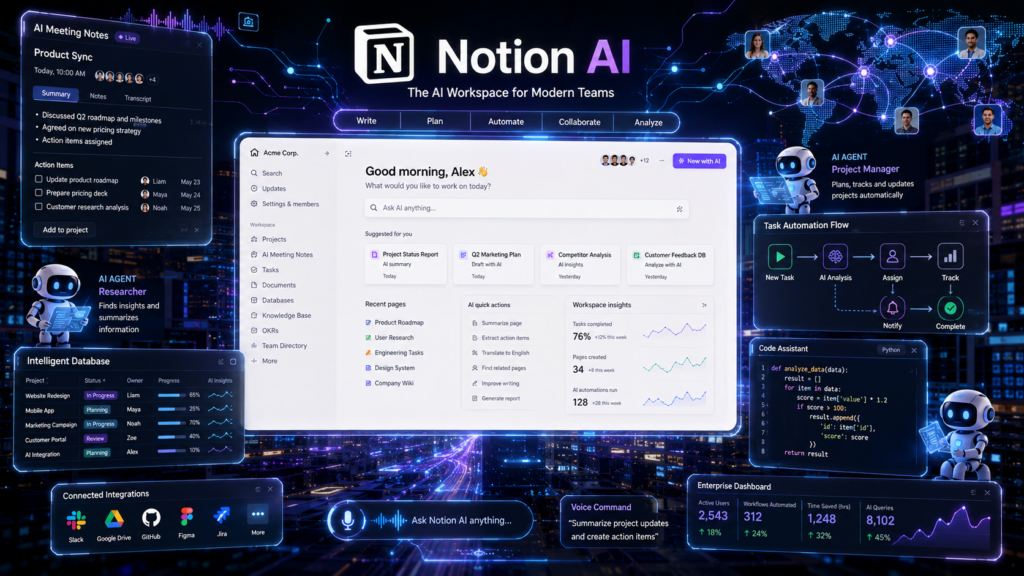
One of the biggest developments driving this shift is Notion’s growing focus on autonomous AI agents. The company recently expanded its Custom Agents ecosystem, allowing businesses to build AI systems capable of automating repetitive workflows, generating reports, routing tasks, analyzing data, and interacting directly with Slack environments. The latest release updates also introduced dedicated agent directories, reusable AI skills, and enhanced private-channel integrations.
This evolution reflects a broader transformation occurring across enterprise software. Companies are increasingly moving away from isolated AI chatbots and toward persistent AI systems integrated directly into operational workflows. Notion AI appears to be capitalizing on that transition faster than many traditional productivity competitors.
The platform’s 2026 roadmap strongly emphasizes what analysts call “context-native AI.” Unlike standalone generative AI applications that operate outside organizational data structures, Notion AI functions directly inside a company’s internal workspace architecture. This enables the AI to reference project databases, meeting notes, internal documentation, task systems, and connected applications while generating responses or automating actions.
That context-aware capability is becoming one of Notion AI’s strongest differentiators in the crowded AI productivity market. Users can ask the platform complex operational questions such as project-status updates, product launch summaries, or meeting analysis requests, and the AI synthesizes information across connected systems instead of responding with generic outputs.
The company has also accelerated technical upgrades at an unusually aggressive pace throughout 2026. Recent releases introduced larger AI context windows, relation-aware database autofill, cross-page reasoning capabilities, voice-based prompting, faster AI response speeds, and customizable workspace-level prompt templates.
Industry observers increasingly view the “Workers for Agents” announcement as one of Notion AI’s most strategically important updates so far. This feature allows AI agents to execute server-side JavaScript and Python operations inside workflows, effectively turning Notion from a collaborative documentation tool into a programmable AI execution environment.
That shift has major implications for enterprise software competition. Instead of simply competing against note-taking apps, Notion AI is now entering territory occupied by workflow automation companies, AI copilots, internal knowledge systems, and lightweight development platforms.
Another reason Notion AI is gaining traction is its multi-model AI strategy. The platform now allows users to work with multiple frontier AI systems inside a single workspace environment, reducing the need for separate subscriptions and fragmented workflows. This consolidation strategy is particularly appealing to startups and remote-first organizations seeking operational simplicity.
The meeting automation segment has emerged as another critical battleground. Notion AI now offers AI Meeting Notes with customizable instructions, automated summaries, action-item extraction, and contextual referencing across workspace knowledge. In a business environment increasingly overwhelmed by virtual collaboration, this functionality is becoming one of the platform’s fastest-growing enterprise use cases.
Still, Notion AI faces growing competition from Microsoft Copilot, Google Workspace AI, ClickUp AI, Atlassian Intelligence, and independent AI-native startups. The challenge for Notion will be maintaining simplicity while adding increasingly complex AI capabilities.
Some analysts also argue that Notion AI’s biggest strength could become its biggest operational challenge. As more automation layers, AI agents, and integrations are introduced, the platform risks becoming overly complex for smaller teams that originally adopted Notion for its minimalist workspace design.
Privacy and governance concerns are also becoming more prominent. Enterprise customers increasingly demand granular AI permissions, audit controls, workspace-specific policies, and secure handling of proprietary internal information. Recent updates introducing workspace-level AI consent controls suggest Notion is already responding to those concerns.
Despite those challenges, Notion AI’s momentum in 2026 is difficult to ignore. The platform is benefiting from a larger market shift in which businesses no longer want AI as a separate destination. They want AI embedded directly into the environments where work already happens.
This trend is reshaping the entire productivity software sector. AI is no longer treated as an optional enhancement layered on top of workplace tools. Instead, AI is becoming the primary interface through which knowledge work itself is organized, retrieved, analyzed, and executed.
For Notion AI, that transformation may represent its biggest opportunity yet. The company is no longer competing merely to become a better productivity app. It is competing to become the intelligent operating layer for modern digital organizations.
Notion AI
Notion AI is the artificial intelligence ecosystem integrated into the Notion productivity platform developed by Notion. Initially launched as an AI writing and summarization assistant, the platform expanded significantly between 2025 and 2026 to include AI agents, enterprise search, meeting automation, workspace-aware reasoning, and workflow orchestration tools. The broader Notion platform serves millions of users globally across startups, enterprises, creators, and remote teams.
Disclaimer: This article and accompanying visual concept are created for informational, analytical, and editorial purposes only. References to Notion AI, artificial intelligence workflows, enterprise productivity systems, and related technologies are based on publicly available information and industry reporting available at the time of writing. The AI-generated artwork is a conceptual illustration and is not officially affiliated with, endorsed by, or representative of Notion Labs, Inc. or any third-party platforms shown or referenced. All trademarks, logos, product names, and brand identities remain the property of their respective owners.
One UI 9: Samsung’s Android 17 Update Rolls Out

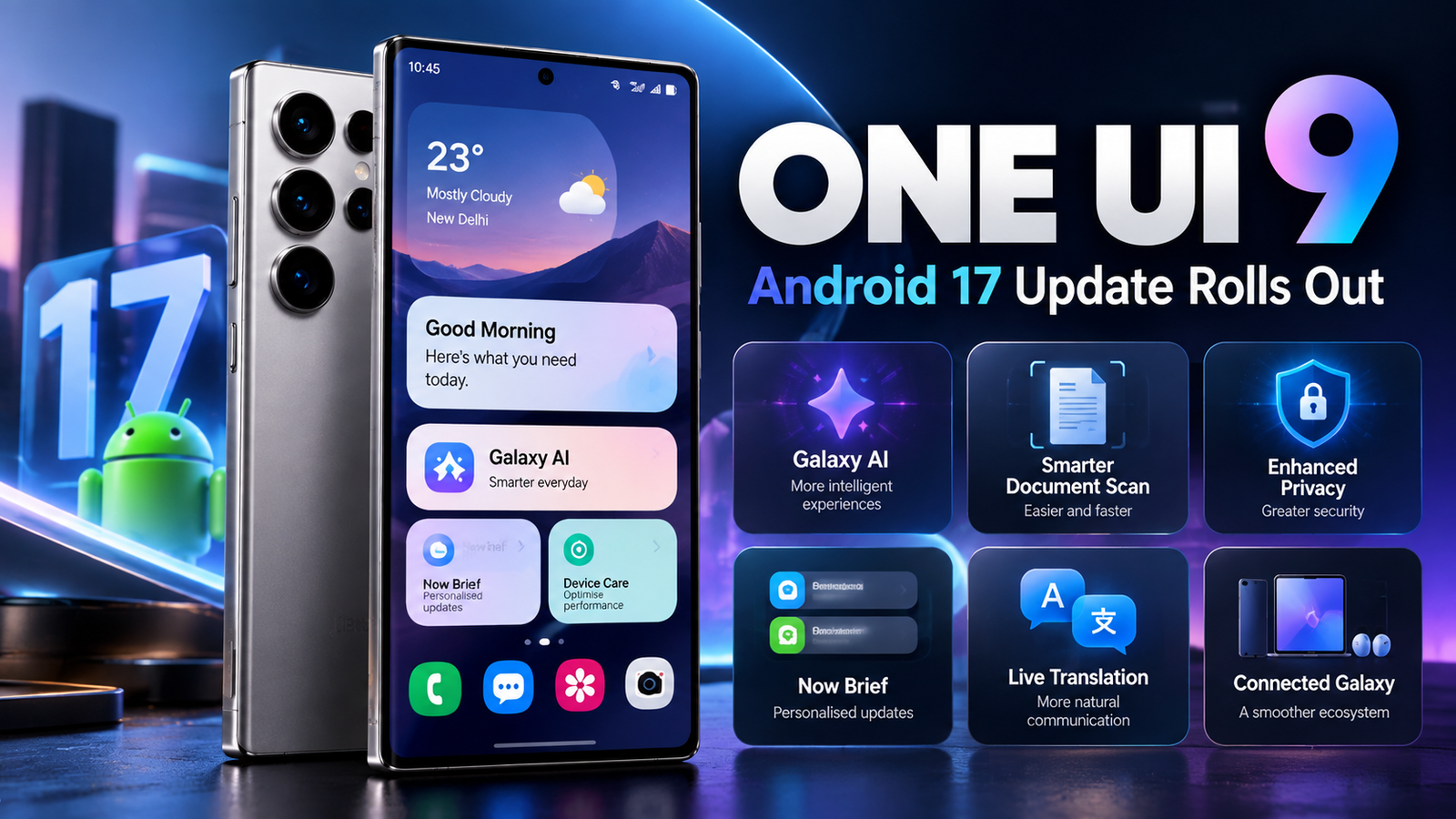
One UI 9 is rolling out with Android 17, Galaxy AI upgrades, privacy tools and new features. Here’s the latest Samsung rollout news and device status. Canon EOS R8 Captures Global Attention in 2026 One UI 9: Samsung’s Android 17 Rollout Gathers Pace Samsung’s One UI 9 rollout is entering an important phase. After months…
Canon EOS R8 Captures Global Attention in 2026

Canon EOS R8 gets a major 2026 buying boost as the R8 Mark II arrives. Check its price, specs, 4K video, 40fps shooting and latest firmware. Household Electric Fan: The Quiet Shift to BLDC Cooling The Canon EOS R8 has suddenly become a more interesting camera in 2026, not because Canon has quietly replaced it,…
Household Electric Fan: The Quiet Shift to BLDC Cooling
A household electric fan is getting smarter in 2026, with BLDC motors, battery backup and better efficiency reshaping how Indian homes stay cool. Redmi Note 17 Pro Max: 10,000mAh Battery Changes Game Household Electric Fan: The Quiet Shift to BLDC Cooling The humble household electric fan is going through a surprisingly important transformation. For decades,…




Pingback: Cursor’s AI Boom Raises New Coding Safety Questions