
Discover the story of the first bus in the world, its inventor, historical impact, and how public transportation evolved into today’s global transit system.
Electric Buses Reshape Public Transportation Worldwide
First Bus in the World: The Remarkable Story Behind Modern Public Transport
Millions of people use buses every day, but few know the fascinating story of the first bus in the world. Long before electric buses, autonomous transit systems, and smart mobility networks, a revolutionary idea transformed urban transportation and laid the foundation for modern public transit.
The concept of a bus may seem simple today, but when it first appeared in the 17th century, it represented one of the most innovative transportation systems ever created. The story of the first bus is closely linked to urban growth, technological advancement, and the changing needs of city populations.
Who Invented the First Bus in the World?
The world’s first organized public bus service is widely credited to French mathematician and philosopher Blaise Pascal.
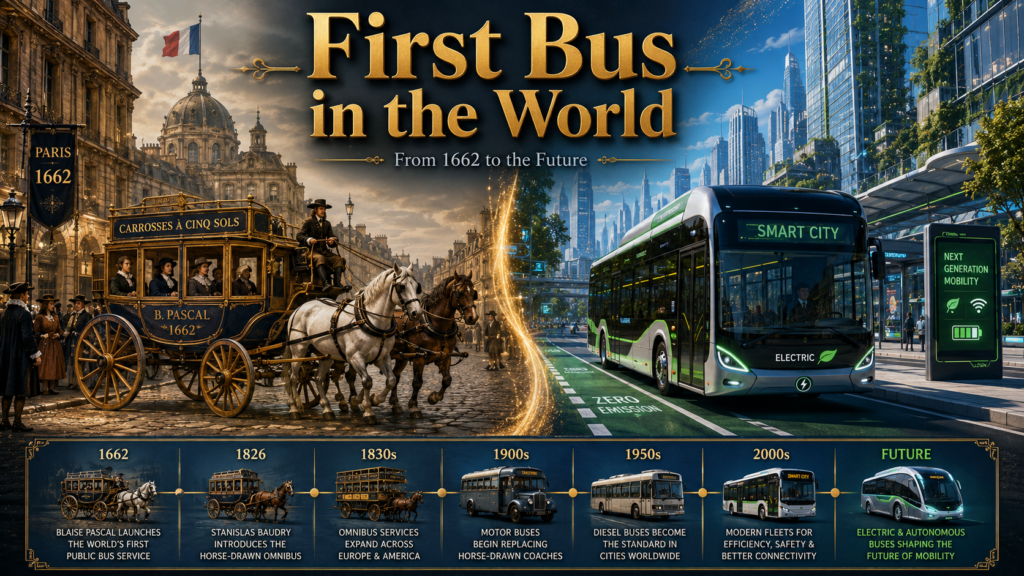
In Paris, France, Pascal developed a system of horse-drawn carriages that operated on fixed routes, charged fixed fares, and stopped at designated locations. This service, known as the Carrosses à Cinq Sols, officially began operations on March 18, 1662. Historians consider it the world’s first fixed-route public transportation system, making it the earliest version of the modern bus network.
The system introduced several concepts still used by public transportation today:
- Fixed routes
- Scheduled services
- Designated stops
- Standardized fares
- Shared passenger transport
Although primitive by modern standards, these innovations fundamentally changed urban mobility.
Why Did the First Bus Service Fail?
Despite its groundbreaking design, Pascal’s bus network faced significant social and regulatory challenges.
Authorities in Paris restricted access to certain social classes, limiting ridership and reducing public support. Protests, operational difficulties, and declining demand eventually led to the closure of the service in 1677. While the original network disappeared, its core transportation principles survived and later inspired future transit systems.




The Birth of the Modern Bus
More than 150 years later, public bus transportation re-emerged in a form closer to what people recognize today.
In 1826, French entrepreneur Stanislas Baudry launched a horse-drawn omnibus service in Nantes, France. Unlike Pascal’s experiment, Baudry’s system became commercially successful and expanded rapidly.
His buses operated on fixed urban routes and carried large numbers of passengers across the city. The success of the Nantes service helped spread the omnibus concept throughout Europe. Within a few years, similar services appeared in Paris, London, New York, Philadelphia, and other growing cities.
How Buses Spread Around the World
The rapid adoption of buses during the 19th century reflected the increasing need for affordable urban transportation.
A key figure in this expansion was George Shillibeer, who helped introduce omnibus services to London in 1829. Soon afterward, bus networks emerged across Europe and North America, connecting residential districts with commercial centers.
By the mid-1800s:
- London had hundreds of horse-drawn buses.
- New York had established regular omnibus routes.
- Major European cities operated extensive public transit systems.
- Public transport became an essential part of urban life.
From Horse-Drawn Coaches to Motor Buses
The next major evolution occurred during the early 20th century when internal combustion engines replaced horses.
Motor buses offered:
- Greater speed
- Increased passenger capacity
- Lower operating costs
- Improved reliability
By the start of the First World War, motor buses had largely replaced traditional horse-drawn vehicles in many cities worldwide. This transition marked the beginning of modern bus transportation.
The Legacy of the First Bus
The influence of the first bus extends far beyond transportation history.
Today’s transit systems continue to rely on the principles first introduced by Pascal and later refined by Baudry:
- Route planning
- Fare collection
- Passenger scheduling
- Network integration
- Urban accessibility
Modern innovations such as electric buses, hydrogen-powered fleets, autonomous vehicles, and smart ticketing systems are built upon concepts developed centuries ago. Recent transit developments around the world continue to push bus technology forward while preserving the core idea of shared public transportation.
Why the First Bus Still Matters Today
The first bus in the world was more than a vehicle. It represented a revolutionary shift in how people moved through cities.
By making transportation more accessible, affordable, and organized, early bus systems helped shape urban development, support economic growth, and improve daily life for millions of people.
From horse-drawn carriages in 17th-century Paris to electric and autonomous buses in the 21st century, the journey of the bus remains one of the most important stories in transportation history.
First Bus in the World
The title of the first bus in the world belongs to Blaise Pascal’s fixed-route public transit service launched in Paris in 1662. Although the original operation lasted only a few years, it introduced the essential principles that continue to define public transportation today.
The evolution from Pascal’s horse-drawn coaches to modern electric and autonomous buses demonstrates how a simple idea can transform societies for centuries. As cities continue investing in sustainable mobility, the legacy of the first bus remains more relevant than ever
Disclaimer: This article is intended for informational and educational purposes only. Historical accounts regarding the first bus in the world are based on widely accepted transportation history records and scholarly sources available at the time of writing. While every effort has been made to ensure accuracy, interpretations of historical events may vary among historians and institutions. Readers are encouraged to consult official transportation archives, museums, and academic publications for further research. The feature image associated with this article is a conceptual artistic representation and may not depict actual historical vehicles, locations, or events with complete historical accuracy.
One UI 9: Samsung’s Android 17 Update Rolls Out

One UI 9 is rolling out with Android 17, Galaxy AI upgrades, privacy tools and new features. Here’s the latest Samsung rollout news and device status. Canon EOS R8 Captures Global Attention in 2026 One UI 9: Samsung’s Android 17 Rollout Gathers Pace Samsung’s One UI 9 rollout is entering an important phase. After months…
Canon EOS R8 Captures Global Attention in 2026

Canon EOS R8 gets a major 2026 buying boost as the R8 Mark II arrives. Check its price, specs, 4K video, 40fps shooting and latest firmware. Household Electric Fan: The Quiet Shift to BLDC Cooling The Canon EOS R8 has suddenly become a more interesting camera in 2026, not because Canon has quietly replaced it,…
Household Electric Fan: The Quiet Shift to BLDC Cooling
A household electric fan is getting smarter in 2026, with BLDC motors, battery backup and better efficiency reshaping how Indian homes stay cool. Redmi Note 17 Pro Max: 10,000mAh Battery Changes Game Household Electric Fan: The Quiet Shift to BLDC Cooling The humble household electric fan is going through a surprisingly important transformation. For decades,…