
Explore the History of Trains from ancient railways to steam engines, bullet trains, and hydrogen rail technology shaping the future of transportation.
Google Pixel 11 Series: AI Flagships Ready for the Next Leap
History of Trains: How Railways Changed the World Forever
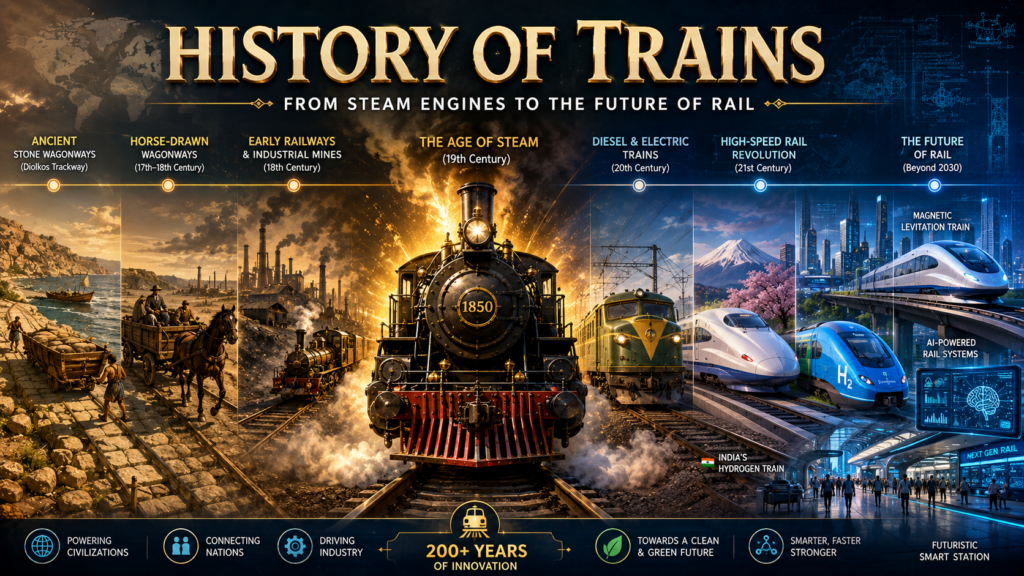
The History of Trains is one of humanity’s greatest engineering stories. From simple wooden wagonways used centuries ago to today’s AI-assisted, hydrogen-powered, and ultra-fast bullet trains, railways have transformed how people travel, trade, and connect across continents.
Even in 2026, the railway industry continues to evolve rapidly. Countries are investing in cleaner propulsion systems, smarter signaling, and next-generation high-speed networks. India’s launch of its first domestically built hydrogen-powered passenger train marks another milestone in this remarkable journey, showing that the story of trains is still being written.
The Earliest Origins of Rail Transport
Long before steam locomotives appeared, civilizations experimented with guided transportation systems. Ancient Greece used the Diolkos, a stone trackway that allowed boats to be transported across the Isthmus of Corinth. Similar wooden trackways later appeared across Europe to move heavy goods more efficiently.
These early innovations introduced the concept of guiding wheels along a fixed path, laying the foundation for modern railways.
The Birth of the Steam Locomotive
The Industrial Revolution completely changed transportation.
In the early nineteenth century, engineers began replacing horse-drawn wagons with steam-powered locomotives. George Stephenson’s famous Locomotion No. 1 and later the Rocket demonstrated that steam engines could move passengers and freight faster and more reliably than ever before.
As railway lines expanded across Britain, Europe, and North America, trains became the backbone of industrial growth, reducing travel times from days to mere hours.
Railways Expand Across the World
The success of steam railways inspired rapid global expansion.
During the nineteenth century, railway networks spread across Asia, Africa, Australia, and South America. Railroads connected ports with inland cities, accelerated industrialization, and opened remote regions for trade and settlement.
Countries quickly realized that railways were not merely transportation systems—they became engines of economic development.
The History of Trains in India
India’s railway story officially began on 16 April 1853, when the country’s first passenger train traveled between Bombay (Mumbai) and Thane.
What started as a 34-kilometre route gradually developed into one of the world’s largest railway networks. Today, Indian Railways operates approximately 25,000 trains daily, transporting hundreds of millions of passengers every month while continuing to modernize through electrification, digital ticketing, advanced safety systems, and station redevelopment.
From Steam to Diesel and Electric Trains
Steam locomotives dominated rail transport for over a century before newer technologies emerged.
Diesel locomotives offered greater efficiency, lower operating costs, and reduced maintenance requirements. Later, electrified rail systems transformed passenger transport even further by providing higher speeds, smoother acceleration, lower emissions, and improved reliability.
Many countries continue replacing older diesel fleets with electric trains as part of broader sustainability initiatives.
The Rise of High-Speed Rail
Japan revolutionized railway travel in 1964 with the introduction of the Shinkansen, commonly known as the Bullet Train.
The success of high-speed rail inspired similar networks in France, Germany, Spain, Italy, South Korea, and China.
Today, China operates the world’s largest high-speed railway network, carrying millions of passengers daily and continuing to expand at an unprecedented pace.
High-speed rail has dramatically reduced travel times while offering an environmentally friendly alternative to short-haul air travel.
Modern Railway Technology
Today’s trains are significantly more advanced than their predecessors.
Modern railway systems incorporate:
- Artificial intelligence for predictive maintenance
- Automatic train protection systems
- Digital signaling
- Satellite-based navigation
- Energy-efficient braking
- Smart passenger information systems
- Real-time monitoring and diagnostics
These innovations improve safety, operational efficiency, and passenger comfort while reducing maintenance costs.
The Hydrogen Revolution in Railways
One of the latest chapters in the History of Trains involves hydrogen-powered locomotives.
Hydrogen fuel cells generate electricity by combining hydrogen with oxygen, producing only water vapor as the primary emission.
In 2026, India introduced its first indigenous hydrogen-powered passenger train, joining several countries exploring hydrogen as a cleaner alternative for routes where full electrification may not be practical. This reflects the global railway industry’s commitment to sustainable transportation.
Railways and Sustainable Transportation
Rail transport remains one of the most energy-efficient forms of mass transportation.
Governments worldwide continue investing in:
- Railway electrification
- Hydrogen propulsion
- Battery-powered regional trains
- Renewable energy integration
- Smart rail infrastructure
- High-speed passenger corridors
These investments support climate goals while reducing dependence on fossil fuels.
The Future of Trains
The next generation of rail transport promises even greater innovation.
Engineers are developing technologies that include:
- Autonomous train operations
- Artificial intelligence-driven traffic management
- Hyper-speed magnetic levitation systems
- Hydrogen-powered long-distance services
- Carbon-neutral railway operations
- Digital twins for predictive infrastructure management
Future railway networks will likely become faster, safer, cleaner, and more connected than ever before.
Why the History of Trains Still Matters
The History of Trains is more than a timeline of engineering achievements. It reflects humanity’s continuous pursuit of faster mobility, stronger economies, and greater connectivity.
From ancient stone trackways and steam locomotives to high-speed rail and hydrogen-powered technology, trains have shaped civilizations, fueled industrial revolutions, and transformed everyday life.
As nations continue investing in sustainable transportation, railways remain one of the most important solutions for the future of global mobility.
History of Trains
Interest in railway history has grown alongside renewed investment in sustainable transportation. Recent developments—including India’s first hydrogen-powered passenger train and continued expansion of high-speed rail networks worldwide—demonstrate how railway innovation continues to evolve nearly two centuries after the first modern steam locomotives entered service.
Disclaimer : This article is published for informational and educational purposes only. The historical information, timelines, technological developments, and future projections related to the History of Trains are based on publicly available historical records, official railway publications, and reputable industry sources available at the time of writing. Railway technologies, infrastructure projects, and future developments may evolve over time. Any trademarks, logos, train names, railway company names, and brand references mentioned in this article are the property of their respective owners. This content is not affiliated with, endorsed by, or sponsored by any railway authority, manufacturer, government agency, or organization. Readers are encouraged to consult official railway organizations and government transportation authorities for the latest and most accurate information.
Canon EOS R8 Captures Global Attention in 2026

Canon EOS R8 gets a major 2026 buying boost as the R8 Mark II arrives. Check its price, specs, 4K video, 40fps shooting and latest firmware. Household Electric Fan: The Quiet Shift to BLDC Cooling The Canon EOS R8 has suddenly become a more interesting camera in 2026, not because Canon has quietly replaced it,…
Household Electric Fan: The Quiet Shift to BLDC Cooling

A household electric fan is getting smarter in 2026, with BLDC motors, battery backup and better efficiency reshaping how Indian homes stay cool. Redmi Note 17 Pro Max: 10,000mAh Battery Changes Game Household Electric Fan: The Quiet Shift to BLDC Cooling The humble household electric fan is going through a surprisingly important transformation. For decades,…
Redmi Note 17 Pro Max: 10,000mAh Battery Changes Game
Redmi Note 17 Pro Max brings a 10,000mAh battery, 100W charging, 120Hz AMOLED and Snapdragon 6 Gen 5. India launch is tipped for September 15, 2026 Price is key Lattice-Based Cryptography: The Quantum-Safe Race Xiaomi Redmi Note 17 Pro Max is now official, but India is the real test The xiaomi redmi note 17 pro…