
Apple MacBook Pro (M3/M5 Max) boosts AI performance, SSD speed, battery life, and creator workflows with next-generation Apple Silicon.
Luvaglio Laptop Still Defines Luxury Tech in 2026
Apple MacBook Pro (M3/M5 Max) Signals a New Era for AI Computing
The latest developments surrounding the Apple MacBook Pro (M3/M5 Max) reveal how Apple is aggressively positioning its professional laptops at the center of the AI computing revolution. With the launch of the M5 Pro and M5 Max-powered MacBook Pro lineup in 2026, Apple is no longer focusing solely on creative professionals. The company is now targeting AI developers, machine learning researchers, software engineers, and enterprise users demanding workstation-grade performance inside a portable device.
Industry analysts describe the new MacBook Pro generation as one of Apple’s most important silicon transitions since the introduction of the original M1 chips. The new architecture powering the M5 Pro and M5 Max models reflects a broader strategy centered around on-device AI processing, faster neural computing, and next-generation GPU acceleration.
Apple’s newest MacBook Pro models introduce major upgrades in CPU architecture, graphics acceleration, storage speeds, unified memory bandwidth, and wireless connectivity. The company claims the latest M5 Max-powered systems deliver dramatically faster AI image generation, local large language model processing, and real-time rendering performance compared to previous MacBook generations.
Why the Apple MacBook Pro (M3/M5 Max) Is Trending Globally
One reason the Apple MacBook Pro (M3/M5 Max) is generating intense industry discussion is the growing demand for local AI computing. As AI workflows increasingly move from cloud-based environments to on-device processing, laptops capable of handling large models efficiently are becoming highly valuable.
Apple’s M5 Max architecture is specifically designed around AI acceleration. According to Apple, the new GPU includes Neural Accelerators integrated directly into each graphics core, enabling significantly faster machine learning workloads and local AI model inference.
The timing is also important. Global interest in AI-capable laptops has surged following rapid adoption of generative AI tools across software development, video editing, design, research, and enterprise productivity sectors. Apple is clearly positioning the MacBook Pro as an AI-first professional machine rather than just a premium creative laptop.
Technology observers note that Apple’s strategy differs from many Windows competitors by emphasizing unified memory efficiency and battery optimization rather than relying exclusively on discrete AI chips. This has allowed MacBook Pro systems to maintain strong thermal performance and long battery life even during demanding computational tasks.
Performance Improvements Are Driving Professional Interest
The Apple MacBook Pro (M3/M5 Max) lineup introduces one of the most significant performance leaps in recent Mac history. Apple states that the M5 Pro and M5 Max chips feature a redesigned Fusion Architecture combining multiple silicon dies into a unified system-on-chip structure optimized for parallel processing and AI computation.
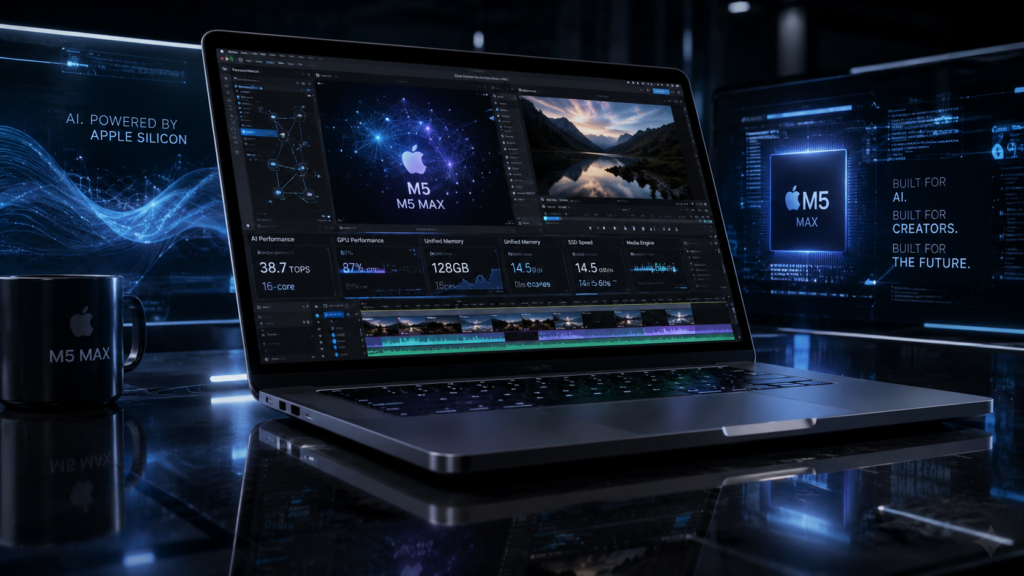
The new MacBook Pro models reportedly deliver:
- Up to 30 percent faster CPU performance compared to M4 Pro systems
- Up to 4x faster AI processing capabilities
- Dramatically improved ray tracing performance
- SSD transfer speeds reaching up to 14.5GB/s
- Support for up to 128GB unified memory on M5 Max systems
- Enhanced local LLM inference performance for AI workloads
These specifications are especially important for professionals working with 8K video editing, AI-assisted software development, advanced simulations, data science, and 3D rendering workflows.
Researchers working with Apple Silicon-based AI infrastructure are also increasingly highlighting the MacBook Pro’s potential for local machine learning experimentation. Recent academic work demonstrated substantial improvements in multimodal AI inference running natively on Apple Silicon hardware.
Apple’s AI Strategy Is Becoming Clearer
The Apple MacBook Pro (M3/M5 Max) launch also offers insight into Apple’s broader long-term AI strategy. Unlike competitors aggressively pushing cloud-dependent AI ecosystems, Apple appears focused on privacy-oriented local AI processing powered directly by Apple Silicon.
This approach aligns with Apple’s increasing emphasis on Apple Intelligence features integrated across macOS and other Apple platforms. The MacBook Pro is becoming a central hardware platform for these AI capabilities.
Industry watchers believe Apple’s unified memory architecture gives the company a major advantage for local AI inference. Unlike many traditional PC architectures that separate GPU and CPU memory pools, Apple Silicon allows faster shared access to large datasets and AI models.
That design philosophy is now influencing how developers evaluate laptops for AI workloads. Many developers increasingly prefer systems capable of running models locally without relying heavily on external cloud infrastructure.
OLED Rumors and Future MacBook Pro Designs
Even with the launch of the M5 Max generation, attention is already shifting toward Apple’s next MacBook Pro redesign cycle. Multiple industry reports suggest Apple is preparing OLED-equipped MacBook Pro models expected in late 2026 or early 2027.
These rumored models could introduce thinner chassis designs, upgraded display technology, and potentially new premium branding strategies for Apple’s highest-end professional laptops.
Analysts believe Apple may use future OLED MacBook Pro systems to further separate mainstream professional users from ultra-premium AI and creator-focused customers. This could significantly reshape the premium laptop market over the next several years.
At the same time, the current M5 Max-powered MacBook Pro systems are already being positioned as some of the most powerful portable AI workstations available today.
The Competitive Pressure on Windows Laptop Makers
The success of the Apple MacBook Pro (M3/M5 Max) lineup is also increasing pressure on Windows laptop manufacturers. Competitors including Dell, ASUS, Lenovo, and HP are accelerating their own AI-PC strategies in response to Apple’s silicon performance gains.
Recent premium Windows laptops powered by Intel’s latest Panther Lake chips have shown major improvements, but many reviewers still compare them directly against MacBook Pro systems in terms of efficiency, thermal control, and battery endurance.
Apple’s combination of hardware integration, battery longevity, AI acceleration, and software optimization continues to give MacBook Pro models strong influence within the premium computing market.
Apple Silicon Is Reshaping the Professional Laptop Market
The broader significance of the Apple MacBook Pro (M3/M5 Max) extends beyond individual hardware specifications. Apple Silicon has fundamentally changed expectations for professional laptops by combining desktop-level performance with exceptional energy efficiency.
The transition away from Intel processors is now nearly complete across Apple’s ecosystem, and macOS support for Intel-based Macs is gradually approaching its end.
For many professional users, the MacBook Pro has evolved from a premium creative device into a central platform for AI development, advanced media production, and high-performance mobile computing.
As the AI race intensifies globally, Apple’s latest MacBook Pro generation demonstrates how consumer laptops are rapidly transforming into sophisticated local AI workstations capable of handling tasks once reserved for specialized desktop systems.
Apple MacBook Pro
The Apple MacBook Pro series underwent a major transformation following Apple’s transition from Intel processors to Apple Silicon beginning with the M1 chip in 2020. The introduction of M3, M4, and now M5-series chips has steadily expanded MacBook Pro capabilities in AI processing, GPU rendering, unified memory performance, and battery efficiency. In 2026, Apple officially introduced the M5 Pro and M5 Max MacBook Pro lineup with major architectural upgrades designed specifically for next-generation AI and professional workloads.
Disclaimer: This article and related visuals are created for informational, editorial, educational, and technology awareness purposes only. References to Apple MacBook Pro (M3/M5 Max), AI computing, product specifications, industry analysis, and future technology trends are based on publicly available information, media reports, analyst discussions, and market observations available at the time of publication. Product specifications, release timelines, software capabilities, and performance claims may change over time and should be independently verified through official Apple announcements and authorized sources. This content is not affiliated with, endorsed by, or officially connected to Apple or any associated organization. All trademarks, product names, logos, and brand references belong to their respective owners. The visuals used are artistic conceptual representations intended for editorial storytelling and technology illustration purposes only.
One UI 9: Samsung’s Android 17 Update Rolls Out

One UI 9 is rolling out with Android 17, Galaxy AI upgrades, privacy tools and new features. Here’s the latest Samsung rollout news and device status. Canon EOS R8 Captures Global Attention in 2026 One UI 9: Samsung’s Android 17 Rollout Gathers Pace Samsung’s One UI 9 rollout is entering an important phase. After months…
Canon EOS R8 Captures Global Attention in 2026

Canon EOS R8 gets a major 2026 buying boost as the R8 Mark II arrives. Check its price, specs, 4K video, 40fps shooting and latest firmware. Household Electric Fan: The Quiet Shift to BLDC Cooling The Canon EOS R8 has suddenly become a more interesting camera in 2026, not because Canon has quietly replaced it,…
Household Electric Fan: The Quiet Shift to BLDC Cooling
A household electric fan is getting smarter in 2026, with BLDC motors, battery backup and better efficiency reshaping how Indian homes stay cool. Redmi Note 17 Pro Max: 10,000mAh Battery Changes Game Household Electric Fan: The Quiet Shift to BLDC Cooling The humble household electric fan is going through a surprisingly important transformation. For decades,…