Discover the complete history of AC, from ancient cooling methods to Willis Carrier’s invention and today’s AI-powered smart air conditioners.
Android in 2026: AI, Updates and New Rules Shape Future
History of AC: How Air Conditioning Changed the Modern World
Few inventions have transformed daily life as profoundly as air conditioning. From making homes more comfortable to enabling modern hospitals, data centers, offices, and manufacturing plants, air conditioning has reshaped the way people live and work. While many think of AC simply as a household appliance, its origins lie in solving an industrial problem rather than providing personal comfort.
Today, as the world faces rising temperatures and increasing energy demands, air conditioning continues to evolve with artificial intelligence, smart energy management, and environmentally friendly refrigerants. Understanding the history of AC reveals not only how far cooling technology has come but also why it remains one of the most important engineering achievements of the modern era. Recent industry campaigns marking “Air Conditioning Invention Day” have also renewed global interest in the origins and future of cooling technology.
The Ancient Origins of Cooling
Long before electricity existed, civilizations searched for ways to escape extreme heat.
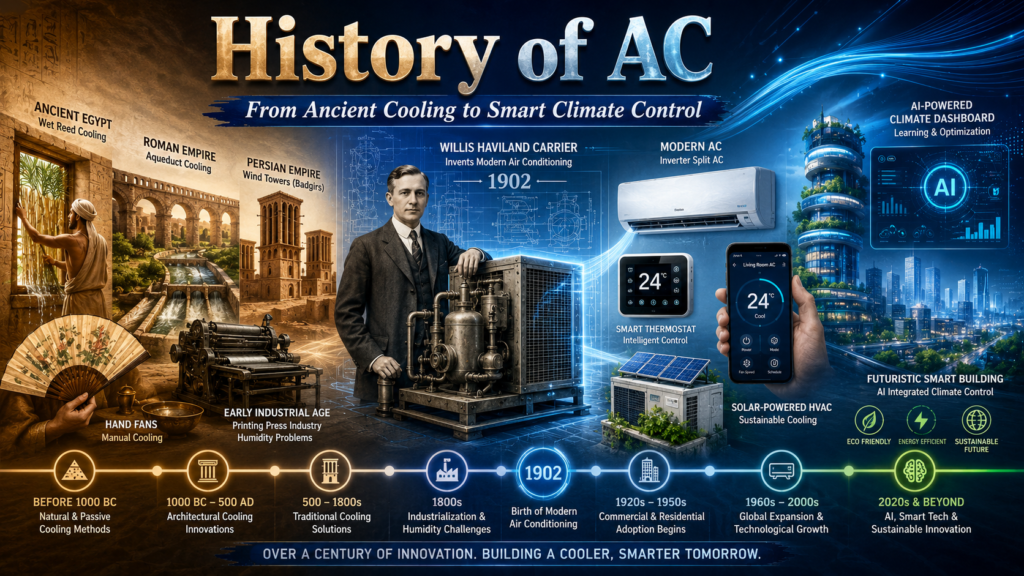
Ancient Egyptians cooled their homes by hanging wet reeds in windows, allowing evaporation to lower indoor temperatures. The Romans engineered aqueduct systems that circulated cool water through the walls of important buildings. In Persia, architects designed wind catchers and underground water channels that naturally reduced indoor temperatures.
These early innovations demonstrated that controlling indoor climate had been a human priority for thousands of years, even though true mechanical air conditioning was still centuries away.
The Birth of Modern Air Conditioning
The modern history of air conditioning began in 1902 with a young engineer named Willis Haviland Carrier.
Carrier was working for the Buffalo Forge Company when he was assigned to solve a humidity problem at the Sackett-Wilhelms Lithographing & Publishing Company in Brooklyn, New York. Excess humidity caused paper to expand and contract, making printing inconsistent and reducing production quality.
Rather than focusing on cooling people, Carrier designed a system that controlled humidity by passing air over chilled coils. The process stabilized both moisture and temperature, creating the world’s first modern air-conditioning system.
This invention marked the birth of the HVAC industry and permanently changed industrial manufacturing.
Why Air Conditioning Was Invented
One of the biggest misconceptions about air conditioning is that it was invented for comfort.
Its original purpose was to improve manufacturing precision.
Industries that quickly adopted air conditioning included:
- Printing
- Textile manufacturing
- Pharmaceutical production
- Food processing
- Tobacco manufacturing
Only later did engineers recognize that the same technology could dramatically improve human comfort inside homes, offices, and public buildings.
Major Milestones in the History of AC
Following Carrier’s breakthrough, air conditioning developed rapidly.
In 1906, Carrier patented his “Apparatus for Treating Air,” establishing the scientific foundation of modern climate control.
During the 1920s, movie theaters became one of the first public spaces to install air conditioning. Audiences flocked to cooled theaters during hot summers, helping boost cinema attendance.
By the late 1920s, skyscrapers, department stores, and office buildings increasingly adopted centralized cooling systems, allowing architects to design taller, sealed buildings without depending solely on natural ventilation.
Residential air conditioning became more affordable after World War II, and by the second half of the twentieth century it had become a standard household appliance in many parts of the world.
How Air Conditioning Changed Society
The impact of AC extends far beyond comfort.
Modern healthcare depends heavily on temperature-controlled environments for surgeries, medicine storage, and patient care.
Computer data centers rely on advanced cooling systems to prevent servers from overheating.
Manufacturing industries maintain strict environmental conditions to produce electronics, pharmaceuticals, and precision equipment.
Air conditioning has also influenced architecture by making glass skyscrapers, shopping malls, airports, and modern office complexes practical in hot climates.
Without climate control, many of today’s cities would look very different.
Air Conditioning in the Age of Smart Technology
The evolution of AC continues today.
Modern systems feature:
- AI-powered climate optimization
- Smart thermostats
- Remote mobile control
- Energy-efficient inverter compressors
- Air purification
- Predictive maintenance
- Voice assistant integration
Manufacturers are increasingly combining artificial intelligence with weather forecasting and battery storage to reduce electricity consumption while maintaining indoor comfort. Recent innovations even explore using air conditioners as grid-supporting energy assets through integrated battery technology.
Environmental Challenges and Sustainable Cooling
Although air conditioning has improved quality of life, it also presents environmental challenges.
Cooling systems consume a significant share of global electricity, and demand continues to rise as temperatures increase worldwide. Manufacturers are therefore focusing on:
- High-efficiency inverter technology
- Low-global-warming-potential refrigerants
- Smart energy management
- Solar-compatible cooling
- AI-driven energy optimization
The future of air conditioning will depend on balancing comfort with sustainability.
What the Future Holds
The next generation of air conditioning is expected to become more intelligent than ever.
Future innovations may include self-learning climate systems, AI-based occupancy detection, predictive maintenance, renewable energy integration, and buildings that automatically optimize cooling based on weather forecasts and electricity demand.
Rather than simply cooling rooms, tomorrow’s air conditioners will function as intelligent environmental management systems that improve comfort while reducing energy consumption.
History of AC
The history of AC is a story of engineering ingenuity and continuous innovation. What began in 1902 as a solution for controlling humidity in a printing factory has become one of the most influential technologies in modern civilization. Air conditioning has transformed healthcare, manufacturing, architecture, transportation, and everyday life.
As climate change increases global cooling demand, the next chapter in the history of air conditioning will be defined not only by smarter technology but also by cleaner, more sustainable solutions that make comfort accessible while protecting the planet.
Air Conditioning
Modern air conditioning was invented by Willis Haviland Carrier on July 17, 1902, to solve humidity problems in a printing plant rather than to cool people. Over the following century, the technology expanded from industrial use to commercial buildings, homes, healthcare, transportation, and digital infrastructure. In 2026, the industry continues to highlight this legacy while advancing AI-enabled, energy-efficient cooling systems.
Disclaimer: This article is intended for informational and educational purposes only. The historical information presented is based on publicly available records and reputable industry sources available at the time of publication. While every effort has been made to ensure accuracy, certain historical dates, technological developments, and industry milestones may be subject to ongoing research and interpretation. Brand names, trademarks, and company names mentioned belong to their respective owners and are used solely for informational purposes. Readers are encouraged to consult official historical archives, manufacturers, and industry organizations for the most up-to-date and authoritative information.
Canon EOS R8 Captures Global Attention in 2026

Canon EOS R8 gets a major 2026 buying boost as the R8 Mark II arrives. Check its price, specs, 4K video, 40fps shooting and latest firmware. Household Electric Fan: The Quiet Shift to BLDC Cooling The Canon EOS R8 has suddenly become a more interesting camera in 2026, not because Canon has quietly replaced it,…
Household Electric Fan: The Quiet Shift to BLDC Cooling

A household electric fan is getting smarter in 2026, with BLDC motors, battery backup and better efficiency reshaping how Indian homes stay cool. Redmi Note 17 Pro Max: 10,000mAh Battery Changes Game Household Electric Fan: The Quiet Shift to BLDC Cooling The humble household electric fan is going through a surprisingly important transformation. For decades,…
Redmi Note 17 Pro Max: 10,000mAh Battery Changes Game
Redmi Note 17 Pro Max brings a 10,000mAh battery, 100W charging, 120Hz AMOLED and Snapdragon 6 Gen 5. India launch is tipped for September 15, 2026 Price is key Lattice-Based Cryptography: The Quantum-Safe Race Xiaomi Redmi Note 17 Pro Max is now official, but India is the real test The xiaomi redmi note 17 pro…