
Explore the History of the automobile from steam-powered vehicles to AI-driven electric cars, including key inventions, milestones, and future trends.
History of Transport: From Wheels to Hydrogen Mobility Today
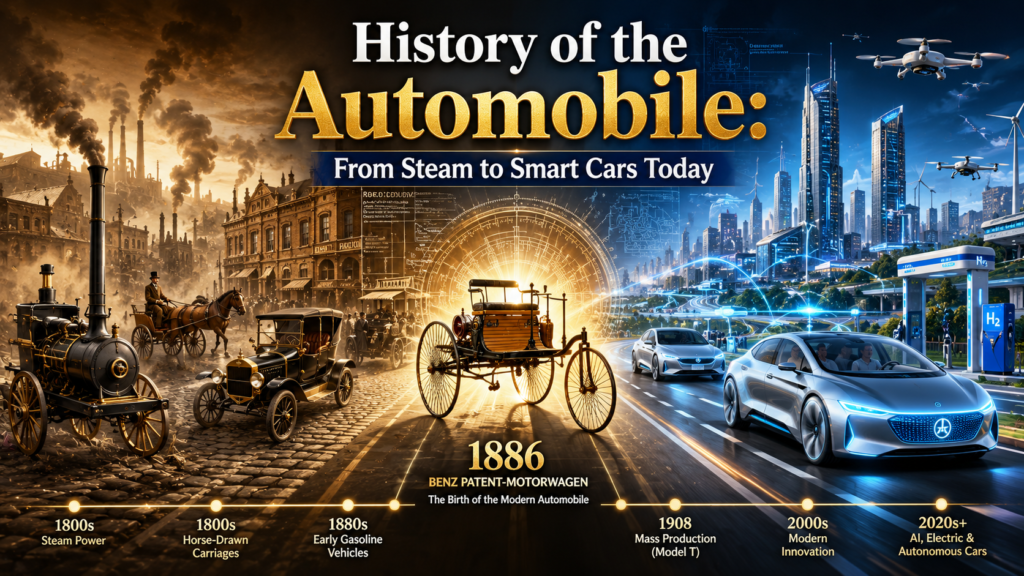
History of the Automobile: From Steam to Smart Cars Today
The History of the automobile is one of humanity’s greatest engineering stories. Over the past two centuries, automobiles have transformed from experimental steam-powered machines into intelligent electric vehicles capable of autonomous driving. Every generation of innovation has reshaped how people travel, work, and connect with the world.
In 2026, interest in automotive history has grown once again as museums and manufacturers celebrate historic milestones while the industry rapidly transitions toward electrification, software-defined vehicles, hydrogen technologies, and artificial intelligence. Recent exhibitions celebrating 140 years of the automobile and major heritage collections highlight how the invention continues to influence transportation today.
The Origins of the Automobile
Long before modern cars existed, inventors dreamed of self-propelled vehicles that could eliminate the need for horses.
During the late eighteenth century, several engineers experimented with steam-powered road vehicles. Although these early machines demonstrated the possibility of mechanical transportation, they were heavy, slow, and difficult to operate.
The real breakthrough arrived during the late nineteenth century with the development of compact internal combustion engines, making practical automobiles possible.
Karl Benz and the First Practical Automobile
The most significant milestone in the History of the automobile came in 1886 when German engineer Karl Benz patented the Benz Patent-Motorwagen.
Widely recognized as the world’s first practical automobile, the three-wheeled vehicle used a gasoline-powered engine specifically designed for road transportation.
Its success became even more remarkable when Bertha Benz completed the world’s first long-distance automobile journey in 1888. Her historic drive demonstrated that automobiles could serve as practical vehicles rather than engineering experiments. Today, this journey is considered one of the defining moments in automotive history.
The Rise of Mass Production
Although automobiles had been invented, they remained expensive luxury products for many years.
Everything changed in 1908 when Henry Ford introduced the Model T.
Ford revolutionized manufacturing by implementing the moving assembly line, dramatically reducing production costs and making automobiles affordable for ordinary families.
Mass production not only transformed transportation but also changed manufacturing worldwide, influencing industries far beyond automobiles.
The Golden Age of Automotive Innovation
Throughout the twentieth century, automobile manufacturers focused on improving reliability, comfort, safety, and performance.
Manufacturers introduced enclosed cabins, electric starters, hydraulic brakes, automatic transmissions, power steering, air conditioning, and advanced suspension systems.
Road networks expanded across Europe, North America, and Asia, encouraging tourism, commerce, suburban development, and economic growth.
By the middle of the twentieth century, owning a car had become a symbol of personal freedom and prosperity.
Safety Becomes a Priority
As vehicle ownership increased, improving passenger safety became a major objective.
Seat belts gradually became standard equipment.
Manufacturers later introduced crumple zones, anti-lock braking systems (ABS), airbags, electronic stability control, traction control, lane-keeping assistance, adaptive cruise control, and automatic emergency braking.
Today’s vehicles combine mechanical engineering with sophisticated software to help prevent accidents before they occur.
The Evolution of Electric Vehicles
Electric vehicles are often considered modern inventions, but their history dates back more than a century.
Early electric cars competed with gasoline vehicles during the late nineteenth and early twentieth centuries before internal combustion engines became dominant.
Advances in lithium-ion batteries, charging infrastructure, and renewable energy have revived electric mobility, making EVs one of the fastest-growing automotive segments worldwide.
The Automobile Enters the Digital Age
Modern automobiles have evolved into highly connected computers on wheels.
Today’s vehicles feature:
- Artificial Intelligence-powered driver assistance
- Cloud-based software updates
- Connected infotainment systems
- Voice assistants
- Advanced navigation
- Smartphone integration
- Vehicle-to-vehicle communication
- Semi-autonomous driving technologies
These innovations continue transforming how people interact with their vehicles.
The Future of the Automobile
The next chapter in the History of the automobile is already unfolding.
Automakers are investing billions in:
- Fully electric vehicles
- Hydrogen fuel-cell technology
- Autonomous driving
- Artificial intelligence
- Smart city integration
- Sustainable manufacturing
- Solid-state batteries
- Vehicle software ecosystems
Industry experts expect future vehicles to become safer, cleaner, more connected, and increasingly autonomous.
Why the History of the Automobile Still Matters
Understanding the History of the automobile helps explain much more than transportation.
Automobiles have influenced:
- Global economies
- Industrial manufacturing
- Urban planning
- Tourism
- International trade
- Energy consumption
- Environmental policy
- Technological innovation
The automobile continues to evolve alongside society, reflecting changing priorities in sustainability, safety, and digital transformation.
Latest Developments in 2026
Automotive heritage remains an important focus in 2026.
Museums across the world are celebrating landmark anniversaries, including exhibitions marking 140 years since the invention of the automobile by Karl Benz and showcasing historically significant vehicles. Automotive manufacturers such as Porsche and Lamborghini are also highlighting major milestones in their engineering heritage while the industry simultaneously accelerates toward electric and AI-powered mobility.
Automobile
The History of the automobile is a remarkable journey of human innovation. From early steam-powered machines and Karl Benz’s pioneering invention to electric vehicles and AI-driven mobility, automobiles have continually reshaped civilization.
As the automotive industry enters an era defined by sustainability, intelligent transportation, and autonomous technology, understanding its history offers valuable insight into where mobility is headed next. The automobile remains far more than a machine—it is one of the defining inventions of modern civilization.
Disclaimer: This article is intended for informational and educational purposes only. The historical information presented is based on publicly available records, museum archives, automotive industry sources, and widely accepted historical research. While every effort has been made to ensure accuracy, certain historical dates, interpretations, and technological developments may vary among sources. References to manufacturers, brands, or technologies are for informational purposes only and do not constitute endorsement. The feature image is a creative artistic representation designed for illustrative purposes and may not accurately depict historical vehicles, timelines, or future automotive concepts.
Canon EOS R8 Captures Global Attention in 2026

Canon EOS R8 gets a major 2026 buying boost as the R8 Mark II arrives. Check its price, specs, 4K video, 40fps shooting and latest firmware. Household Electric Fan: The Quiet Shift to BLDC Cooling The Canon EOS R8 has suddenly become a more interesting camera in 2026, not because Canon has quietly replaced it,…
Household Electric Fan: The Quiet Shift to BLDC Cooling

A household electric fan is getting smarter in 2026, with BLDC motors, battery backup and better efficiency reshaping how Indian homes stay cool. Redmi Note 17 Pro Max: 10,000mAh Battery Changes Game Household Electric Fan: The Quiet Shift to BLDC Cooling The humble household electric fan is going through a surprisingly important transformation. For decades,…
Redmi Note 17 Pro Max: 10,000mAh Battery Changes Game
Redmi Note 17 Pro Max brings a 10,000mAh battery, 100W charging, 120Hz AMOLED and Snapdragon 6 Gen 5. India launch is tipped for September 15, 2026 Price is key Lattice-Based Cryptography: The Quantum-Safe Race Xiaomi Redmi Note 17 Pro Max is now official, but India is the real test The xiaomi redmi note 17 pro…