Explore the history of the telephone, from Alexander Graham Bell’s first call to modern smartphones, and discover how it transformed global communication.
iPhone 18: Latest Leaks, AI Features and Launch Expectations
History of the Telephone: From Bell to the Smartphone Era
The history of the telephone is more than the story of a remarkable invention. It is the story of how humanity learned to communicate across great distances in real time, forever changing the way people lived, worked, and connected with one another. From Alexander Graham Bell’s groundbreaking experiment in 1876 to today’s AI-powered smartphones, the telephone has evolved into one of the most influential technologies ever created.
Interest in the history of the telephone has seen renewed attention throughout 2026 as the world commemorates the 150th anniversary of the first successful telephone call. Museums, technology organizations, and historians have been celebrating this milestone with exhibitions, public events, and educational initiatives highlighting the invention that reshaped global communication.
How Communication Worked Before the Telephone
Before the telephone, people relied on handwritten letters, messengers, carrier pigeons, and later the electric telegraph to exchange information over long distances.
Although the telegraph revolutionized communication by transmitting coded electrical signals, it required trained operators and could not carry the human voice. Scientists and inventors throughout the nineteenth century searched for a way to transmit speech directly through electrical wires.
Their efforts laid the foundation for one of history’s greatest technological breakthroughs.
Alexander Graham Bell and the Birth of the Telephone
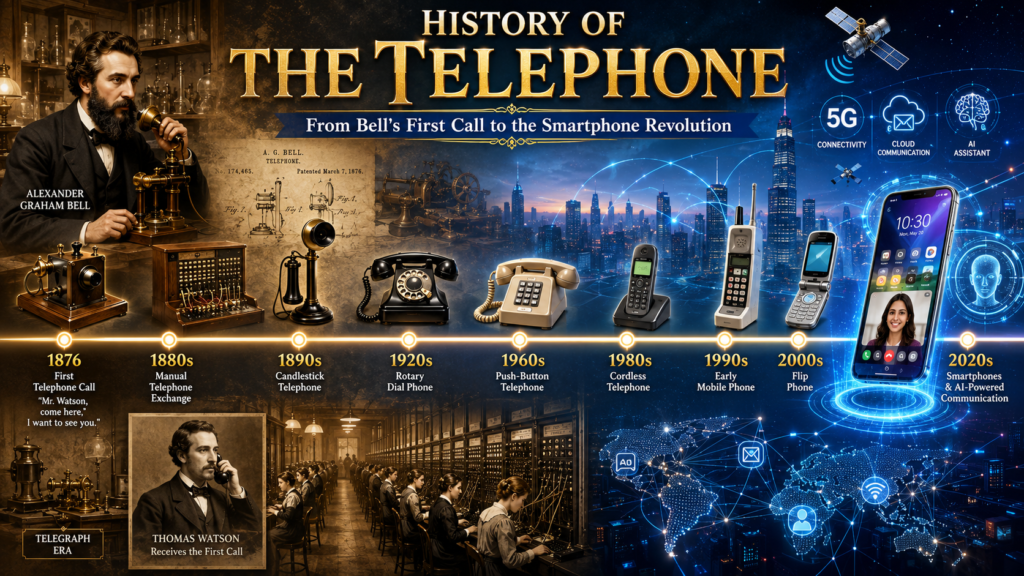
The turning point arrived on March 7, 1876, when Alexander Graham Bell received a U.S. patent for his revolutionary communication device.
Just three days later, on March 10, 1876, Bell successfully transmitted intelligible speech to his assistant Thomas Watson. His famous words,
“Mr. Watson, come here, I want to see you.”
became one of the most significant moments in technological history.
That first successful call demonstrated that human speech could travel through electrical wires, opening an entirely new era of communication.
The Race to Invent the Telephone
Although Alexander Graham Bell is widely recognized as the inventor of the telephone, history reveals that several innovators were working toward similar goals.
Inventors including Elisha Gray, Johann Philipp Reis, Antonio Meucci, and others developed important concepts related to voice transmission.
Bell’s achievement came from successfully patenting and commercially developing a practical telephone system, making his invention the foundation of modern telecommunications.
Today, historians acknowledge that the telephone emerged through the combined efforts of multiple pioneers while recognizing Bell’s critical role in transforming the technology into everyday reality.
How Early Telephones Worked
The earliest telephones were remarkably simple compared to modern devices.
A transmitter converted sound vibrations into electrical signals, which traveled through copper wires to a receiver that transformed those signals back into sound.
These first models featured separate mouthpieces and receivers connected by visible wiring. Conversations could only occur between directly connected devices until telephone exchanges were introduced.
Despite their simplicity, these early instruments represented an extraordinary leap in engineering.
The Rise of Telephone Networks
As telephone adoption increased, cities established central exchanges where operators manually connected calls by inserting cables into switchboards.
Telephone operators became an essential part of daily life, helping connect homes, businesses, hospitals, and government offices.
By the early twentieth century, automatic switching technology gradually replaced manual exchanges, making telephone communication faster, more reliable, and more accessible.
This transformation enabled millions of people to communicate instantly without requiring operator assistance.
Telephones Transform Society
The impact of the telephone extended far beyond technology.
Businesses could negotiate deals within minutes rather than waiting days or weeks for letters.
Families remained connected across cities and countries.
Emergency services responded more quickly to crises.
Governments coordinated national infrastructure more efficiently.
The telephone fundamentally changed commerce, healthcare, education, journalism, and public administration, making real-time communication an essential part of modern society.
The Evolution from Rotary Phones to Smartphones
Telephone technology continued evolving throughout the twentieth century.
Heavy wooden wall-mounted telephones gave way to rotary dial models, followed by push-button telephones, cordless devices, mobile phones, and eventually smartphones.
Today’s smartphones combine voice communication with internet access, photography, navigation, artificial intelligence, digital payments, and countless other functions.
What began as a simple voice-transmission device has become one of humanity’s most versatile personal technologies.
The Telephone’s Lasting Influence on the Digital World
Modern communication technologies still rely on many principles first established during the early development of the telephone.
Voice over Internet Protocol (VoIP), video conferencing, cloud communication platforms, and AI-powered virtual assistants all trace their origins to Bell’s pioneering work.
Even though messaging apps and social media dominate everyday communication, voice calling remains a vital component of global connectivity.
Why the History of the Telephone Matters Today
The year 2026 marks 150 years since the invention and first successful telephone call, prompting renewed global interest in telecommunications history.
Museums, including the Library of Congress, the Charles River Museum of Industry & Innovation, and science organizations in Boston, have organized exhibitions and public events celebrating this milestone. These events showcase Bell’s original work, historic telephones, and the remarkable journey from wired communication to today’s intelligent mobile devices.
At the same time, historians continue exploring the broader story behind the invention, highlighting the contributions of multiple innovators while examining how the telephone became one of the defining technologies of the modern era.
The Legacy of the Telephone
Few inventions have influenced humanity as profoundly as the telephone.
It connected families separated by oceans, accelerated scientific collaboration, strengthened businesses, improved emergency response, and laid the foundation for today’s interconnected digital world.
The smartphone in every pocket is a direct descendant of Bell’s first experimental device. While the technology has changed dramatically over the past century and a half, its original purpose remains the same: bringing people closer together through communication.
As the world celebrates 150 years of the telephone, its history continues to remind us that a single breakthrough can reshape civilization for generations.
Telephone
The telephone was patented by Alexander Graham Bell in March 1876 and demonstrated through the first successful voice call on March 10, 1876. Over the following 150 years, it evolved from wired analog systems into today’s digital smartphones, becoming one of the most transformative inventions in human history. The 150th anniversary in 2026 has renewed interest through museum exhibitions, historical publications, and educational events celebrating its global impact.
Disclaimer: This article is intended for informational and educational purposes only. While every effort has been made to ensure the accuracy of the historical information presented, some events, dates, and interpretations may vary based on academic research and historical sources. The content is compiled from publicly available historical records, museum archives, and authoritative references to provide a comprehensive overview of the history of the telephone. The feature image is an artistic illustration created for visual representation and should not be considered a historically accurate depiction of people, inventions, or events. Readers are encouraged to consult official historical archives, museums, and scholarly publications for detailed research and primary source information.
One UI 9: Samsung’s Android 17 Update Rolls Out

One UI 9 is rolling out with Android 17, Galaxy AI upgrades, privacy tools and new features. Here’s the latest Samsung rollout news and device status. Canon EOS R8 Captures Global Attention in 2026 One UI 9: Samsung’s Android 17 Rollout Gathers Pace Samsung’s One UI 9 rollout is entering an important phase. After months…
Canon EOS R8 Captures Global Attention in 2026

Canon EOS R8 gets a major 2026 buying boost as the R8 Mark II arrives. Check its price, specs, 4K video, 40fps shooting and latest firmware. Household Electric Fan: The Quiet Shift to BLDC Cooling The Canon EOS R8 has suddenly become a more interesting camera in 2026, not because Canon has quietly replaced it,…
Household Electric Fan: The Quiet Shift to BLDC Cooling
A household electric fan is getting smarter in 2026, with BLDC motors, battery backup and better efficiency reshaping how Indian homes stay cool. Redmi Note 17 Pro Max: 10,000mAh Battery Changes Game Household Electric Fan: The Quiet Shift to BLDC Cooling The humble household electric fan is going through a surprisingly important transformation. For decades,…