
Zapier evolves into an AI automation powerhouse in 2026 with agents, guardrails, and enterprise workflows reshaping how businesses scale productivity.
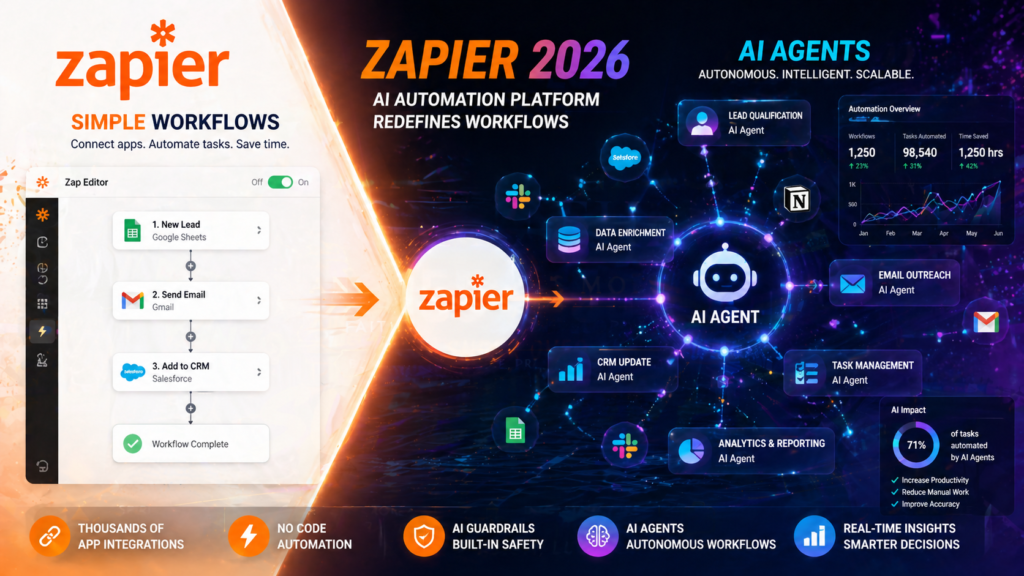
Kissflow 2026: AI Workflows Reshape Enterprise Automation
Zapier in 2026: From Automation Tool to AI Orchestration Engine
The story of Zapier in 2026 is no longer about simple task automation. It has evolved into a full-scale AI orchestration platform, redefining how businesses connect apps, automate workflows, and deploy intelligent agents across operations.
Recent developments show that Zapier is positioning itself at the center of the AI-driven productivity revolution. With new features like AI agents, guardrails, and deeper integrations, the platform is moving beyond “if-this-then-that” automation into autonomous workflow execution.
The Big Shift: AI-Powered Workflows at Scale
One of the most significant updates shaping Zapier’s trajectory is its focus on AI-powered workflows. According to recent industry findings, businesses are increasingly using automation not for isolated tasks but for end-to-end process orchestration.
Zapier’s internal analysis of thousands of workflows highlights a clear trend: organizations that succeed with AI are those that integrate it deeply into their operational pipelines rather than treating it as a standalone tool.
This shift is reflected in how Zapier now enables users to build intelligent systems that can handle lead routing, customer engagement, and internal decision-making workflows without manual intervention.
AI Guardrails: Solving the Trust Problem in Automation
A major concern with AI adoption has been reliability and safety. Zapier’s introduction of “AI Guardrails” directly addresses this issue.
The feature allows teams to embed safety checks within workflows, detecting sensitive data, preventing prompt injection, and filtering harmful outputs before they reach downstream systems.
This is a critical evolution. As automation becomes more autonomous, governance and compliance are no longer optional—they are foundational. Zapier’s approach signals a broader industry move toward responsible AI deployment.
Rise of AI Agents: Automation Becomes Autonomous
Zapier’s introduction of AI agents marks a turning point in workflow automation. These agents act as digital teammates capable of executing multi-step tasks across thousands of integrated apps.
Instead of manually configuring workflows, users can now assign objectives, and the system orchestrates the execution. Zapier agents can interact with tools like CRMs, spreadsheets, and communication platforms, effectively bridging data silos.
This capability positions Zapier closer to enterprise AI platforms rather than traditional automation tools.
Enterprise Adoption: AI as Core Infrastructure
Zapier’s research into enterprise AI trends reveals a fundamental change in how organizations perceive automation. AI is no longer experimental—it is becoming a core operational layer.
A majority of enterprise leaders now expect measurable ROI from AI investments, with many treating it as essential infrastructure rather than discretionary spending.
This aligns with Zapier’s product evolution, which increasingly focuses on scalability, governance, and enterprise-grade controls.
Expanding Ecosystem: Integrations and Developer Power
Zapier’s strength has always been its ecosystem, and in 2026, it continues to expand aggressively. The platform now connects with thousands of applications, enabling seamless cross-functional automation.
New developer-focused features like “Action Runs” allow companies to embed Zapier’s capabilities directly into their own products, unlocking access to tens of thousands of actions across integrations.
This effectively turns Zapier into an infrastructure layer for automation, rather than just a standalone tool.
The Competitive Landscape: Rising Pressure from AI Platforms
While Zapier remains a leader, competition is intensifying. Platforms like Make, n8n, and emerging AI-native tools are pushing the boundaries of automation.
At the same time, tech giants are entering the space with AI-driven workflow builders, signaling a broader industry convergence between automation and artificial intelligence.
Zapier’s response has been clear: double down on usability, integrations, and AI-first capabilities.
Practical Impact: How Businesses Are Using Zapier Today
In real-world scenarios, Zapier continues to deliver measurable productivity gains. Businesses are using it to automate lead management, synchronize data across platforms, and streamline communication workflows.
The platform enables teams to connect tools like CRMs, collaboration apps, and databases into unified systems that operate without manual intervention.
This reduces operational friction and allows teams to focus on higher-value tasks.
What Zapier Is and Why It Matters
Zapier was founded as a no-code automation platform designed to connect apps and automate repetitive tasks. Over time, it became a critical tool for startups, marketers, and enterprises alike.
Its core concept—“Zaps”—allowed users to trigger actions between applications. Today, that concept has evolved into complex, AI-driven workflows that can span entire business processes.
The platform’s ability to integrate with thousands of applications has made it a foundational tool in the modern SaaS ecosystem.
Challenges: Cost, Complexity, and Competition
Despite its advancements, Zapier faces several challenges. Pricing remains a concern for smaller teams, especially with the introduction of AI-focused tiers.
Additionally, as workflows become more complex, maintaining and optimizing them requires ongoing oversight. The rise of open-source and developer-centric alternatives also adds pressure on Zapier’s market position.
Still, its ease of use and ecosystem breadth continue to give it a competitive edge.
Conclusion: Zapier’s Strategic Pivot Defines Automation’s Future
The evolution of Zapier in 2026 reflects a broader transformation in the technology landscape. Automation is no longer about saving time—it is about building intelligent, self-operating systems.
By integrating AI deeply into its platform, introducing governance mechanisms, and expanding its ecosystem, Zapier is redefining what workflow automation looks like in the modern enterprise.
As businesses continue to adopt AI at scale, platforms like Zapier will play a central role in shaping how work gets done.
Disclaimer : This article is based on publicly available information, industry reports, and recent news updates related to Zapier and AI-driven automation platforms. While every effort has been made to ensure accuracy and relevance, the content is intended for informational and editorial purposes only. The analysis and opinions presented in this article reflect a general interpretation of current trends in automation and artificial intelligence and do not represent official statements from Zapier or any affiliated organizations. Product features, capabilities, and developments may change over time and may vary based on official updates. Readers are advised to refer to Zapier’s official website, product documentation, and verified industry sources for the most accurate and up-to-date information.
One UI 9: Samsung’s Android 17 Update Rolls Out

One UI 9 is rolling out with Android 17, Galaxy AI upgrades, privacy tools and new features. Here’s the latest Samsung rollout news and device status. Canon EOS R8 Captures Global Attention in 2026 One UI 9: Samsung’s Android 17 Rollout Gathers Pace Samsung’s One UI 9 rollout is entering an important phase. After months…
Canon EOS R8 Captures Global Attention in 2026

Canon EOS R8 gets a major 2026 buying boost as the R8 Mark II arrives. Check its price, specs, 4K video, 40fps shooting and latest firmware. Household Electric Fan: The Quiet Shift to BLDC Cooling The Canon EOS R8 has suddenly become a more interesting camera in 2026, not because Canon has quietly replaced it,…
Household Electric Fan: The Quiet Shift to BLDC Cooling
A household electric fan is getting smarter in 2026, with BLDC motors, battery backup and better efficiency reshaping how Indian homes stay cool. Redmi Note 17 Pro Max: 10,000mAh Battery Changes Game Household Electric Fan: The Quiet Shift to BLDC Cooling The humble household electric fan is going through a surprisingly important transformation. For decades,…





Pingback: Vellum AI 2026: The Rise of Agentic AI Platforms