
Zapier AI is expanding rapidly in 2026 with AI agents, governance tools, and enterprise automation reshaping digital workflows globally.
Cursor’s AI Boom Raises New Coding Safety Questions
The automation industry is entering a new phase in 2026, and Zapier AI is positioning itself at the center of that transformation. Once known primarily for simple no-code workflow automation, Zapier has now evolved into a full-scale AI orchestration platform focused on autonomous agents, enterprise governance, and AI-powered operational infrastructure.
Over the past several months, Zapier AI has gained major industry attention as businesses increasingly move beyond traditional workflow automation into what analysts describe as “agentic operations” — systems where AI agents can independently execute tasks, coordinate across applications, and manage complex digital processes with minimal human involvement.
The company’s latest product announcements reveal how aggressively Zapier is expanding into enterprise AI infrastructure. One of the most discussed developments is the launch of AI Guardrails by Zapier, a governance layer designed to monitor AI-powered workflows for security risks, sensitive data exposure, jailbreak attempts, and prompt injection attacks. The system can automatically detect personally identifiable information and prevent unsafe automation actions before they spread across connected applications.
The introduction of these controls reflects a much larger industry shift. As AI automation becomes more deeply integrated into enterprise systems, governance and observability are emerging as critical concerns. Zapier’s own enterprise AI transformation report found that only a small percentage of organizations believe they currently have mature AI governance systems in place, even as AI budgets continue to grow rapidly across global enterprises.
At the same time, Zapier is heavily investing in autonomous AI agents. Recent updates confirmed that Zapier AI Agents have moved beyond beta testing and are now being positioned as fully operational “AI teammates” capable of interacting with thousands of applications simultaneously. Unlike traditional trigger-based automations, these agents can dynamically plan tasks, retrieve information, and execute multi-step workflows independently.
This evolution represents a significant change in how automation platforms are being used. Earlier generations of no-code tools focused mainly on repetitive operational tasks such as sending notifications or synchronizing databases. Zapier AI is now moving toward systems capable of decision-making, contextual reasoning, and adaptive workflow management.
The broader technology industry is also adapting around this trend. Reports published this month suggest software companies are increasingly redesigning applications specifically for AI agents rather than human users. Industry leaders argue that future software competition may revolve less around user interfaces and more around APIs, permissions, and machine-to-machine communication infrastructure. Zapier was highlighted among the companies already preparing for this transition.
Another major development involves enterprise deployment strategy. Zapier has expanded administrative controls that allow organizations to centrally govern chatbot access, monitor billing-level AI activity, manage workflow documentation, and maintain audit trails across automation systems. These updates are aimed directly at large organizations attempting to scale AI adoption without losing operational oversight.
Industry analysts increasingly see Zapier AI as part of a larger race between AI orchestration platforms including Make, n8n, Gumloop, and enterprise AI workflow providers. However, Zapier’s competitive advantage continues to be its enormous integration ecosystem. The company now supports connections across more than 9,000 applications and tens of thousands of triggers and actions, giving enterprises a massive automation surface area.
The company is also trying to position itself as an “AI-first workplace infrastructure” provider rather than merely an automation startup. Zapier recently opened internal AI transformation discussions publicly, showcasing how the company itself is restructuring around AI-native operations.
At the workforce level, Zapier’s research has highlighted another emerging challenge: AI literacy. Recent surveys cited by the company found that most enterprise leaders consider AI skills urgent, yet employee training programs remain underdeveloped across many organizations. This gap could become one of the defining operational problems of the AI economy over the next several years.
The significance of Zapier AI’s expansion goes beyond automation alone. The company is helping define how AI systems interact with enterprise software ecosystems at scale. As businesses increasingly rely on AI agents to manage customer operations, internal workflows, sales systems, IT infrastructure, and data movement, platforms like Zapier may become foundational digital operating layers inside modern organizations.
What makes the current moment particularly important is that the market is no longer debating whether AI automation will become mainstream. The debate has shifted toward how safely, transparently, and effectively enterprises can operationalize autonomous systems without creating governance failures or infrastructure risks.
Zapier AI’s 2026 strategy reflects that transition clearly: automation is no longer just about saving time. It is becoming a framework for how organizations coordinate software, people, and AI systems together inside increasingly autonomous digital environments.
Zapier
Zapier was founded in 2011 as a no-code workflow automation platform connecting cloud applications through automated triggers and actions. Over time, the company expanded from simple integrations into advanced workflow orchestration across business systems.
The launch of AI-powered workflows, AI agents, and enterprise governance tools marked a major strategic shift for the company. Zapier AI now focuses heavily on autonomous task execution, natural language workflow generation, and scalable AI orchestration for enterprise operations.
The company’s platform currently supports integrations across thousands of applications including Slack, Salesforce, Gmail, HubSpot, Notion, OpenAI, and Microsoft ecosystems.
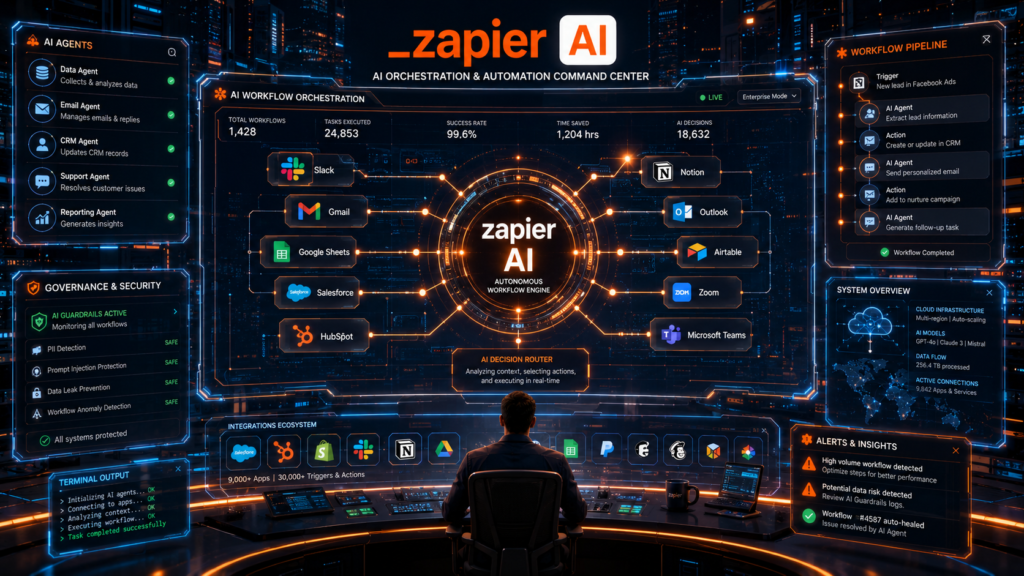
Disclaimer: This image is a conceptual digital illustration created for editorial, informational, and creative visualization purposes only. The depicted AI dashboards, automation systems, workflow interfaces, integrations, and enterprise environments are fictional representations inspired by modern automation technologies. “Zapier” and all related trademarks, logos, and platform names belong to their respective owners. No official affiliation, endorsement, or partnership is implied.
One UI 9: Samsung’s Android 17 Update Rolls Out

One UI 9 is rolling out with Android 17, Galaxy AI upgrades, privacy tools and new features. Here’s the latest Samsung rollout news and device status. Canon EOS R8 Captures Global Attention in 2026 One UI 9: Samsung’s Android 17 Rollout Gathers Pace Samsung’s One UI 9 rollout is entering an important phase. After months…
Canon EOS R8 Captures Global Attention in 2026

Canon EOS R8 gets a major 2026 buying boost as the R8 Mark II arrives. Check its price, specs, 4K video, 40fps shooting and latest firmware. Household Electric Fan: The Quiet Shift to BLDC Cooling The Canon EOS R8 has suddenly become a more interesting camera in 2026, not because Canon has quietly replaced it,…
Household Electric Fan: The Quiet Shift to BLDC Cooling
A household electric fan is getting smarter in 2026, with BLDC motors, battery backup and better efficiency reshaping how Indian homes stay cool. Redmi Note 17 Pro Max: 10,000mAh Battery Changes Game Household Electric Fan: The Quiet Shift to BLDC Cooling The humble household electric fan is going through a surprisingly important transformation. For decades,…





Pingback: Falcon Supernova iPhone 6 Still Defines Luxury Tech Elite