
Explore the history of transport from ancient wheels to hydrogen trains, major milestones, modern innovations, and the future of global mobility.
History of Electric Light: From Edison to Smart LEDs Today
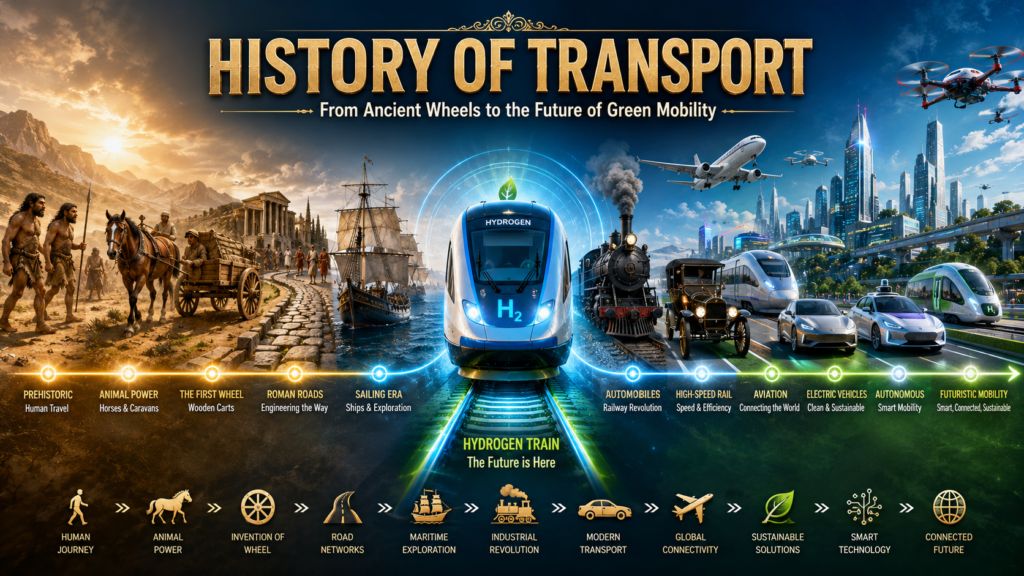
History of Transport: From Wheels to Hydrogen Mobility Today
The history of transport is one of humanity’s greatest stories of innovation. Every civilization has depended on transportation to connect people, exchange goods, expand knowledge, and build economies. From the invention of the wheel thousands of years ago to today’s hydrogen-powered trains and autonomous vehicles, transport has continuously evolved to meet the changing needs of society.
In 2026, transportation history is once again making headlines as countries invest in cleaner mobility solutions while preserving historic transport heritage. India’s launch of its first hydrogen fuel-cell train represents a significant milestone in the next chapter of transportation evolution, demonstrating how centuries of innovation continue to shape the future.
Why the History of Transport Still Matters
Transportation has never been simply about moving from one place to another.
It has transformed civilizations, enabled global trade, accelerated industrial revolutions, connected cultures, and influenced nearly every aspect of modern life. Understanding the history of transport helps explain how today’s interconnected world became possible and offers insight into the technologies shaping tomorrow.
Every major leap in transportation has fundamentally changed human society—from animal-powered travel to steam engines, automobiles, aviation, and high-speed rail.
The Earliest Forms of Human Transportation
Long before roads and railways existed, humans relied on walking as their primary means of travel.
Early communities transported goods by carrying them or using domesticated animals such as horses, donkeys, camels, oxen, and elephants. Rivers naturally became transportation corridors, leading to the development of wooden boats and canoes that connected settlements and encouraged trade.
The invention of the wheel around 3500 BCE marked one of history’s most transformative innovations. Wheeled carts dramatically improved the movement of goods and laid the foundation for land transportation as civilizations expanded.
Ancient Civilizations and Expanding Trade
As societies became more organized, transportation networks grew increasingly sophisticated.
The Romans built extensive road systems that connected vast territories across Europe, Asia, and Africa. These roads enabled faster military movement, efficient administration, and flourishing commerce.
At sea, civilizations developed stronger sailing vessels that crossed oceans and established international trade routes. Maritime exploration connected continents, introducing new goods, cultures, and technologies to different parts of the world.
The Industrial Revolution Changed Everything
The eighteenth and nineteenth centuries witnessed one of the greatest transformations in transportation history.
Steam engines revolutionized both railways and ships. Railroads dramatically reduced travel times, while steamships made international trade faster and more reliable.
Cities expanded rapidly as rail transport enabled people to commute longer distances and industries to distribute products across nations.
The Industrial Revolution established transportation as the backbone of modern economic development.
The Rise of Automobiles
The invention of the internal combustion engine brought another historic shift.
Automobiles gradually replaced horse-drawn carriages, offering greater speed, flexibility, and personal mobility. Companies like Ford popularized mass production, making cars affordable for ordinary families.
Road infrastructure expanded worldwide, and highways became essential components of national development.
Cars transformed urban planning, tourism, logistics, and everyday life in ways that continue today.
Aviation Connected the World
The Wright brothers’ successful powered flight in 1903 opened an entirely new era.
Commercial aviation soon allowed people to travel across continents within hours rather than weeks.
Air transport revolutionized tourism, international business, emergency services, scientific research, and humanitarian relief efforts.
Today, billions of passengers travel by air each year, making aviation one of the most influential transportation systems ever created.
Modern Transportation Enters the Digital Age
The twenty-first century has introduced smart mobility powered by digital technologies.
Electric vehicles, autonomous driving systems, intelligent traffic management, GPS navigation, high-speed rail, drone deliveries, and artificial intelligence are redefining transportation efficiency.
Governments worldwide are investing in sustainable infrastructure to reduce emissions while improving accessibility and safety.
Digital transformation has made transportation more connected than ever before.
The Latest Chapter: Hydrogen and Green Mobility
One of the most significant transportation developments in 2026 is India’s launch of its first hydrogen fuel-cell train.
Powered by hydrogen instead of diesel, the train emits only water vapor while reducing carbon emissions. The project reflects the growing global commitment to sustainable transportation and positions India alongside countries already investing in hydrogen rail technology.
Across the world, transport organizations are also preserving historical vehicles while embracing future technologies. Museums in London and other cities are expanding exhibitions to showcase how transportation innovation continues to influence modern society.
Preserving Transport Heritage
While innovation drives the future, preserving transportation history remains equally important.
Historic railways, vintage automobiles, classic aircraft, steam trams, and maritime museums help future generations understand how mobility evolved over centuries.
Recent museum redevelopment projects and heritage restoration initiatives demonstrate growing public interest in transportation history and its cultural significance.
The Future of Transportation
Transportation is entering one of its most exciting periods.
Electric mobility continues to expand worldwide, while hydrogen fuel, autonomous vehicles, hyperloop concepts, sustainable aviation fuels, and AI-powered traffic systems promise cleaner, safer, and more efficient travel.
The future will likely combine multiple transportation technologies designed to reduce environmental impact while improving convenience and accessibility.
Although technologies continue to evolve, the fundamental purpose of transportation remains unchanged: connecting people, communities, and opportunities.
Frequently Asked Questions
What is the history of transport?
The history of transport refers to the evolution of how humans move people and goods, beginning with walking and animal-powered travel and progressing through wheels, ships, railways, automobiles, aircraft, and modern sustainable transport.
Why was the wheel important?
The invention of the wheel revolutionized land transportation by making it easier to move heavy goods and supporting the growth of trade and civilization.
What changed during the Industrial Revolution?
Steam-powered railways and ships dramatically reduced travel times, expanded trade, and accelerated industrial and economic growth.
What is the newest trend in transportation?
Hydrogen-powered trains, electric vehicles, autonomous driving, artificial intelligence, and sustainable mobility solutions are among today’s most significant transportation innovations.
Why is transportation history important?
Transportation history explains how technological innovation shaped civilization, commerce, communication, and globalization while providing valuable lessons for future mobility.
History of Transport
The history of transport is ultimately the story of human progress. Every breakthrough—from the first wheel to hydrogen-powered trains—has brought societies closer together and expanded economic and cultural opportunities.
As nations continue investing in sustainable transportation and preserving historic achievements, the journey of mobility is far from over. The next chapter promises cleaner technologies, smarter infrastructure, and even greater global connectivity, continuing a remarkable story that began thousands of years ago.
Disclaimer : This article is intended for educational, informational, and historical purposes only. The information is compiled from historical records, scholarly research, publicly available sources, and recent developments in the transportation sector. While every effort has been made to ensure accuracy, historical interpretations and technological timelines may vary among researchers and institutions. References to current transportation projects, innovations, or technologies are included to provide contemporary context and do not constitute an endorsement of any organization, government, or manufacturer. Readers are encouraged to consult authoritative historical publications, academic resources, and official transportation agencies for detailed research and the most up-to-date information.
Canon EOS R8 Captures Global Attention in 2026

Canon EOS R8 gets a major 2026 buying boost as the R8 Mark II arrives. Check its price, specs, 4K video, 40fps shooting and latest firmware. Household Electric Fan: The Quiet Shift to BLDC Cooling The Canon EOS R8 has suddenly become a more interesting camera in 2026, not because Canon has quietly replaced it,…
Household Electric Fan: The Quiet Shift to BLDC Cooling

A household electric fan is getting smarter in 2026, with BLDC motors, battery backup and better efficiency reshaping how Indian homes stay cool. Redmi Note 17 Pro Max: 10,000mAh Battery Changes Game Household Electric Fan: The Quiet Shift to BLDC Cooling The humble household electric fan is going through a surprisingly important transformation. For decades,…
Redmi Note 17 Pro Max: 10,000mAh Battery Changes Game
Redmi Note 17 Pro Max brings a 10,000mAh battery, 100W charging, 120Hz AMOLED and Snapdragon 6 Gen 5. India launch is tipped for September 15, 2026 Price is key Lattice-Based Cryptography: The Quantum-Safe Race Xiaomi Redmi Note 17 Pro Max is now official, but India is the real test The xiaomi redmi note 17 pro…