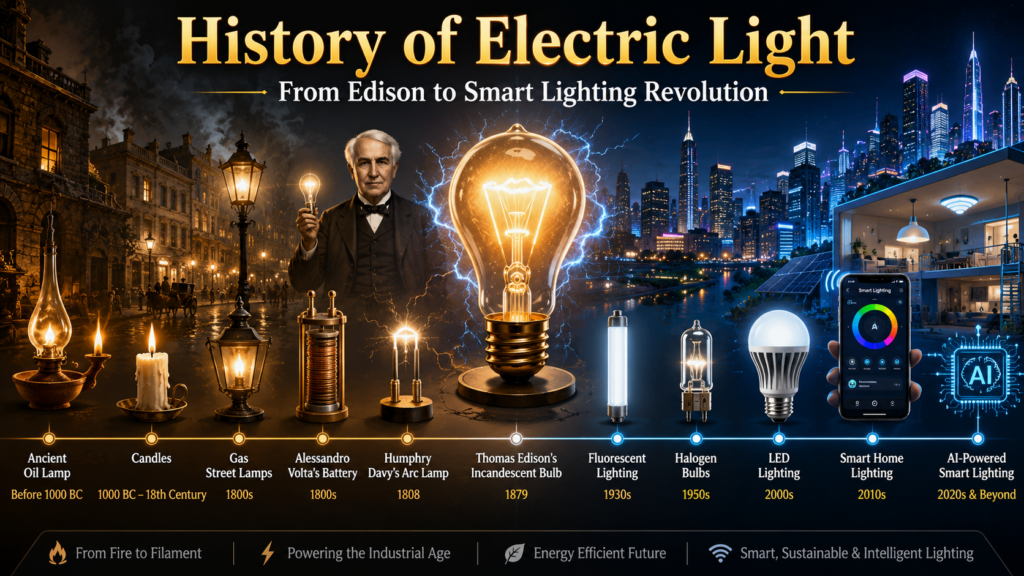
Explore the History of Electric Light from early experiments to Edison, Tesla, LEDs, and smart lighting innovations shaping homes and cities today.
History of the Telephone: From Bell to the Smartphone Era
History of Electric Light: How One Invention Changed Human Civilization Forever
The History of Electric Light is one of the most remarkable stories of scientific innovation. Before electric lighting transformed the world, people relied on candles, oil lamps, and gaslights to illuminate their homes and streets. These methods were expensive, inefficient, and often dangerous.
The arrival of practical electric lighting changed everything. It extended productive hours, improved public safety, revolutionized industries, and reshaped modern cities. Today, lighting has evolved far beyond simple illumination. Smart LEDs, AI-powered lighting systems, and energy-efficient technologies continue to redefine how we experience light in homes, offices, hospitals, and public spaces.
Recent developments in intelligent lighting solutions demonstrate that the journey of electric light is still unfolding, with manufacturers focusing on human well-being, sustainability, and energy efficiency.
Life Before Electric Light
For thousands of years, civilizations depended on natural sunlight during the day and primitive lighting sources after sunset.
Ancient Egyptians, Romans, Greeks, Chinese, and Indians used oil lamps fueled by animal fat or vegetable oils. Candles later became common throughout Europe, while gas lighting emerged in the late eighteenth and early nineteenth centuries, especially in urban areas.
Although gas lamps illuminated cities more effectively than candles, they required extensive infrastructure and posed fire and health hazards.
Scientists began searching for safer and more efficient alternatives.
The Scientific Foundations of Electric Light
The development of electric light was not the achievement of a single inventor. Instead, it resulted from decades of experimentation by scientists across Europe and America.
In 1800, Alessandro Volta invented the electric battery, providing a stable source of electricity for experiments.
Soon afterward, Humphry Davy demonstrated one of the earliest electric arc lamps by passing current between carbon rods. The lamp produced intense light but consumed enormous amounts of power, making it unsuitable for everyday use.
Throughout the nineteenth century, researchers continued improving electric lighting technologies in pursuit of a practical household solution.
Thomas Edison and the Practical Light Bulb
Perhaps the most recognized name in the History of Electric Light is Thomas Alva Edison.
Although Edison did not invent the first light bulb, he successfully developed a practical incandescent lamp in 1879 that could burn for many hours while remaining commercially viable.
His greatest contribution extended beyond the bulb itself. Edison designed a complete electrical distribution system that enabled homes and businesses to receive reliable electricity.
This combination of innovation and infrastructure accelerated the widespread adoption of electric lighting across the United States and eventually around the world.
Nikola Tesla and the Expansion of Electric Power
While Edison popularized incandescent lighting, Nikola Tesla transformed electricity distribution through alternating current (AC).
Tesla’s AC system allowed electricity to travel over long distances with greater efficiency than direct current (DC), making nationwide electrification possible.
Without efficient power transmission, electric lighting would have remained limited to small local networks.
The collaboration and competition between pioneers such as Edison, Tesla, George Westinghouse, Joseph Swan, and others laid the foundation for today’s electrical infrastructure.
The Evolution of Electric Lighting
The twentieth century witnessed rapid advancements in lighting technology.
Incandescent bulbs illuminated homes for decades before fluorescent lighting became the preferred choice for offices, schools, and commercial buildings due to improved energy efficiency.
Halogen lamps later offered brighter illumination and longer lifespans.
The biggest transformation arrived with Light Emitting Diodes (LEDs). Modern LEDs consume far less electricity while lasting significantly longer than traditional bulbs. They also produce less heat and offer exceptional brightness.
Today, LEDs dominate global lighting markets because they reduce electricity consumption while supporting environmental sustainability. The lighting industry is now advancing toward smarter, more connected, and more efficient LED systems.
Smart Lighting Is Shaping the Future
Electric lighting has entered an entirely new era.
Modern lighting systems now integrate artificial intelligence, motion sensors, Internet of Things (IoT) connectivity, voice assistants, adaptive brightness, and circadian lighting that adjusts according to human biological rhythms.
Leading manufacturers are developing lighting products designed not only to illuminate spaces but also to improve comfort, productivity, and overall well-being. Recent innovations include ceiling lighting that recreates the experience of natural daylight indoors and AI-enabled lighting solutions for homes and businesses.
Recent Developments in Lighting Technology
The lighting industry continues to evolve rapidly.
Recent international exhibitions have highlighted AI-powered lighting systems, intelligent automation, digital photonics, and energy-efficient LED technologies. Companies are focusing on connected lighting ecosystems that combine sustainability with enhanced user experiences.
The International Energy Agency also notes that the next generation of LED lighting emphasizes smarter controls, circular product design, and even greater energy efficiency as countries seek to reduce electricity consumption and carbon emissions.
Why the History of Electric Light Still Matters
The invention of electric light transformed nearly every aspect of human life.
Factories became more productive by operating beyond daylight hours.
Hospitals gained safer environments for emergency care.
Educational institutions extended learning opportunities into the evening.
Cities became safer through illuminated streets.
Scientific research accelerated as laboratories operated around the clock.
Modern digital economies, smart cities, and sustainable infrastructure all continue to depend upon reliable and efficient lighting technologies.
Frequently Asked Questions
Who invented the electric light?
Electric light resulted from the contributions of many inventors. Thomas Edison developed the first commercially practical incandescent bulb, while Joseph Swan, Humphry Davy, Nikola Tesla, and others made equally important contributions.
When was the first practical electric light invented?
Thomas Edison successfully demonstrated a practical incandescent light bulb in 1879.
Why did LEDs replace incandescent bulbs?
LEDs consume much less electricity, last significantly longer, generate less heat, and reduce maintenance costs compared with incandescent lamps.
What is smart lighting?
Smart lighting uses LED technology combined with sensors, wireless communication, artificial intelligence, and automation to provide intelligent illumination and energy savings.
What is the future of electric lighting?
The future includes AI-powered lighting, human-centric illumination, adaptive daylight simulation, IoT-connected lighting systems, and increasingly sustainable technologies.
History of Electric Light
The History of Electric Light is a story of continuous innovation rather than a single invention. From primitive oil lamps to intelligent LED ecosystems, each generation has built upon the discoveries of those before it.
Electric lighting has transformed human civilization by improving safety, extending productivity, supporting healthcare, enabling education, and powering economic growth. As technology advances toward smarter and more sustainable solutions, electric light remains one of humanity’s most influential inventions, continuing to illuminate not only our homes but also the future itself.
Disclaimer: This article is intended for informational and educational purposes only. The historical information presented is based on widely accepted scientific research, historical records, and publicly available sources. The development of electric lighting was the result of contributions from numerous inventors, engineers, and scientists over many decades, and interpretations of individual achievements may vary among historians. References to recent technological advancements and industry developments are included solely to provide current context and do not constitute endorsements of any company, product, or technology. Readers are encouraged to consult authoritative historical and scientific sources for detailed research and further study.
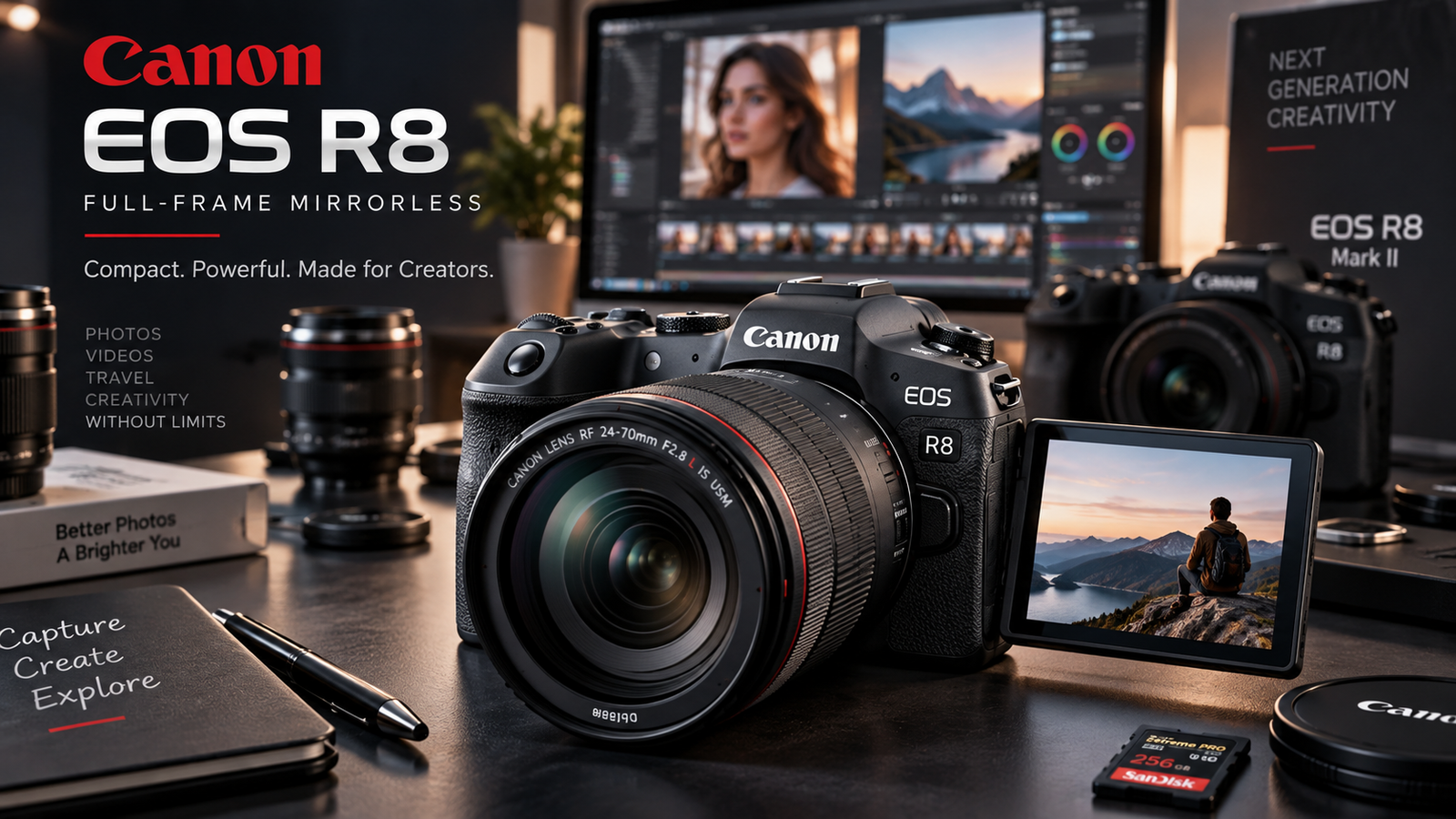
Canon EOS R8 Captures Global Attention in 2026

Canon EOS R8 gets a major 2026 buying boost as the R8 Mark II arrives. Check its price, specs, 4K video, 40fps shooting and latest firmware. Household Electric Fan: The Quiet Shift to BLDC Cooling The Canon EOS R8 has suddenly become a more interesting camera in 2026, not because Canon has quietly replaced it,…
Household Electric Fan: The Quiet Shift to BLDC Cooling

A household electric fan is getting smarter in 2026, with BLDC motors, battery backup and better efficiency reshaping how Indian homes stay cool. Redmi Note 17 Pro Max: 10,000mAh Battery Changes Game Household Electric Fan: The Quiet Shift to BLDC Cooling The humble household electric fan is going through a surprisingly important transformation. For decades,…
Redmi Note 17 Pro Max: 10,000mAh Battery Changes Game
Redmi Note 17 Pro Max brings a 10,000mAh battery, 100W charging, 120Hz AMOLED and Snapdragon 6 Gen 5. India launch is tipped for September 15, 2026 Price is key Lattice-Based Cryptography: The Quantum-Safe Race Xiaomi Redmi Note 17 Pro Max is now official, but India is the real test The xiaomi redmi note 17 pro…