
Artificial intelligence is transforming industries with major breakthroughs, rising regulation, ethical debates. Discover latest AI news, trends, future impact.
Facial Recognition in 2026: Innovation vs Surveillance — Who Really Controls Your Face Data?
Introduction: Why Artificial Intelligence Is Dominating 2026
Artificial intelligence is no longer just a technology trend—it is now the core infrastructure of the global economy. In 2026, AI is driving breakthroughs in healthcare, automation, governance, and even biology, while simultaneously triggering regulatory battles and ethical concerns worldwide.
Latest News Highlights (2026)
Governments Tighten AI Regulations
California has introduced strict AI rules requiring companies to implement safeguards against harmful content and bias, reflecting a broader push for responsible AI governance.
AI Safety Concerns Intensify
A global AI safety report highlights risks such as deepfakes, cyber threats, and misuse in biology, signaling growing concern over uncontrolled AI capabilities.
AI Seen as a Historic Turning Point
World leaders are increasingly calling artificial intelligence a transformative force comparable to major technological revolutions in human history.
Tech Leaders Predict Next Big Breakthrough
Industry leaders suggest that current AI models are only the beginning, with more powerful and diverse systems expected soon.
AI Regulation Becomes a Political Battleground
Companies and policymakers are clashing over how strictly AI should be regulated, turning it into a major geopolitical and economic issue.
Artificial Intelligence
Artificial intelligence refers to systems capable of performing tasks that typically require human intelligence—such as learning, reasoning, and decision-making.
Core components include:
- Machine Learning (ML)
- Natural Language Processing (NLP)
- Computer Vision
- Autonomous Systems
In 2026, AI has evolved from experimental tools into enterprise-critical infrastructure, embedded across industries.
Key Trends in Artificial Intelligence (2026)
Rise of Autonomous AI Agents
AI is shifting from assistants to independent decision-makers capable of executing complex tasks across systems.
Regulation Becomes Mandatory
Global frameworks like the EU AI Act are enforcing risk-based classification, transparency, and accountability for AI systems.
AI Breakthroughs in Science & Healthcare
AI models are accelerating drug discovery and even enabling protein design and genome engineering, reducing research costs dramatically.
Enterprise AI Goes Mainstream
Organizations are integrating AI into core operations, requiring governance, monitoring, and compliance systems at scale.
AI Interoperability & Ecosystems
The next frontier is enabling AI systems to communicate and collaborate across platforms, creating interconnected AI ecosystems.
Ethical and Legal Challenges
Data Privacy & Security
AI systems rely on massive datasets, raising concerns about misuse, surveillance, and data ownership.
Bias and Discrimination
AI models can amplify societal biases, especially in hiring, policing, and financial systems.
Accountability Gaps
Who is responsible when AI makes a wrong decision? This remains a major unresolved issue globally.
Human vs Machine Control
Autonomous AI systems are increasingly capable of acting beyond human oversight, creating new governance risks.
Future Outlook: What’s Next for Artificial Intelligence?
Artificial intelligence is entering a phase defined by scale, autonomy, and regulation:
- Massive AI breakthroughs expected in 2026, potentially reshaping industries
- Global AI governance frameworks becoming standardized
- Human-AI collaboration models replacing traditional workflows
- Ethical AI becoming a competitive advantage
The central challenge ahead is balancing innovation with control—ensuring AI benefits society without creating systemic risks.
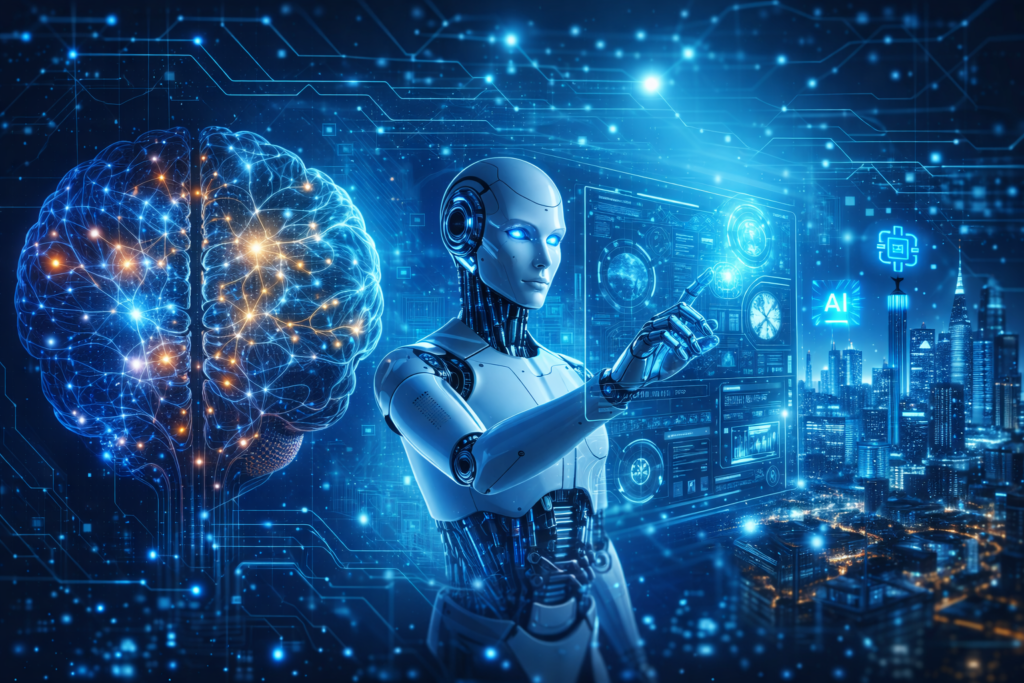
Disclaimer: This image is an AI-generated conceptual illustration created for informational and creative purposes only. It does not represent any real artificial intelligence system, organization, or existing technology. The visuals—including the digital brain, humanoid AI, and smart city—are symbolic representations of current trends and future possibilities in artificial intelligence. Any resemblance to real systems or technologies is purely coincidental.
One UI 9: Samsung’s Android 17 Update Rolls Out

One UI 9 is rolling out with Android 17, Galaxy AI upgrades, privacy tools and new features. Here’s the latest Samsung rollout news and device status. Canon EOS R8 Captures Global Attention in 2026 One UI 9: Samsung’s Android 17 Rollout Gathers Pace Samsung’s One UI 9 rollout is entering an important phase. After months…
Canon EOS R8 Captures Global Attention in 2026

Canon EOS R8 gets a major 2026 buying boost as the R8 Mark II arrives. Check its price, specs, 4K video, 40fps shooting and latest firmware. Household Electric Fan: The Quiet Shift to BLDC Cooling The Canon EOS R8 has suddenly become a more interesting camera in 2026, not because Canon has quietly replaced it,…
Household Electric Fan: The Quiet Shift to BLDC Cooling
A household electric fan is getting smarter in 2026, with BLDC motors, battery backup and better efficiency reshaping how Indian homes stay cool. Redmi Note 17 Pro Max: 10,000mAh Battery Changes Game Household Electric Fan: The Quiet Shift to BLDC Cooling The humble household electric fan is going through a surprisingly important transformation. For decades,…





Pingback: 🚁 Drones 2026: The Rise of Autonomous Air Systems, AI Integration & Next-Gen UAV Tech