
Drones are evolving with AI, autonomy, and advanced sensors. Discover the latest drone technology trends, innovations, future developments shaping UAV systems.
Artificial Intelligence 2026: Breakthrough Boom, Policy Wars & the Race to Control the Future
Introduction: Drones as Core Technology Infrastructure
Drones are no longer experimental flying devices—they are now intelligent, networked, and autonomous systems forming the backbone of modern digital infrastructure.
In 2026, drones are driven by breakthroughs in artificial intelligence, edge computing, sensor fusion, and connectivity, transforming them into fully autonomous aerial platforms.
Latest Technology News Highlights (2026)
AI-Connected Emergency Drones with Satellite Integration
New “first responder” drones now integrate satellite connectivity (like Starlink), enabling long-range autonomous operations beyond traditional networks. These systems can carry medical payloads and operate for extended durations with automated battery swapping.
Indigenous Drone R&D and Scalable Manufacturing
Drone companies are building advanced UAV ecosystems with AI-enabled swarm systems, precision strike capabilities, and large-scale manufacturing infrastructure, signaling a shift toward industrial-grade drone engineering.
Next-Gen Drone Hardware & Propulsion Systems
Modern drones are integrating jet propulsion, anti-jamming navigation systems, and advanced onboard computing, significantly improving range, speed, and operational reliability.
Autonomous Interceptor Drones
New anti-drone systems feature AI-guided interception with “fire-and-forget” capabilities, marking a leap in autonomous aerial defense technologies.
What Defines Modern Drones?
Drones (UAVs) are now cyber-physical systems combining:
- AI-based decision-making
- Advanced sensors (LiDAR, thermal, multispectral)
- Real-time data processing
- Autonomous navigation systems
By 2026, drones are evolving into self-operating platforms capable of executing missions with minimal human intervention.
Key Technology Trends in Drones (2026)
AI-Powered Autonomous Systems
Modern drones are powered by AI models that enable:
- Real-time obstacle avoidance
- Dynamic route optimization
- Predictive analytics
AI integration allows drones to learn from environments and adapt autonomously.
Edge Computing + Satellite Connectivity
Drones are increasingly integrated with:
- Edge computing for on-device processing
- Satellite networks for long-range communication
This enables real-time decision-making without relying on ground infrastructure.
Drone Swarm Intelligence
Swarm technology allows multiple drones to operate collaboratively using distributed AI.
Applications include:
- Environmental monitoring
- Large-scale mapping
- Disaster response
Swarm systems are rapidly moving from research to real-world deployment.
Advanced Sensor Fusion
Drones now combine multiple sensors:
- LiDAR for 3D mapping
- Thermal imaging for detection
- High-resolution cameras
This fusion enhances precision, situational awareness, and data accuracy.
Extended Flight & Energy Efficiency
Technological improvements include:
- Longer battery life
- Hybrid propulsion systems
- Automated battery swapping
These innovations enable long-duration missions and continuous operations.
BVLOS & Smart Airspace Integration
Beyond Visual Line of Sight (BVLOS) technology allows drones to operate across long distances.
- AI-assisted navigation
- Air traffic integration systems
- Real-time monitoring frameworks
This is a key step toward fully autonomous drone ecosystems.
Emerging Drone Tech Applications
Smart Cities
Drones are integrated into urban systems for:
- Traffic monitoring
- Infrastructure inspection
- Public safety
Autonomous Logistics
Drone delivery systems are transitioning from pilot programs to scalable infrastructure, especially in emerging markets like India.
Precision Agriculture
AI-powered drones analyze crop health, optimize irrigation, and increase yield efficiency.
Geospatial Intelligence
Drones equipped with advanced sensors are revolutionizing mapping, surveying, and environmental monitoring.
Technical Challenges in Drone Innovation
Cybersecurity Risks
Connected drones are vulnerable to:
- Signal spoofing
- Data interception
- Remote hijacking
Power Limitations
Battery technology remains a constraint for long-duration operations.
AI Reliability & Autonomy Limits
Fully autonomous drones require:
- Robust decision-making algorithms
- Fail-safe systems
- Real-time adaptability
Interoperability Issues
Different drone platforms often lack standardized communication protocols, limiting ecosystem integration.
Future Outlook: The Next Phase of Drone Technology
The next wave of drone innovation will focus on:
Fully Autonomous AI Drones
Self-learning drones capable of independent mission planning and execution.
Internet of Drones (IoD)
Interconnected drone networks communicating in real-time across cloud and edge systems.
Hybrid Energy Systems
Solar-powered and hydrogen fuel drones for ultra-long endurance missions.
Industrial-Scale Drone Ecosystems
Drones will become part of enterprise infrastructure, integrated into workflows across industries.
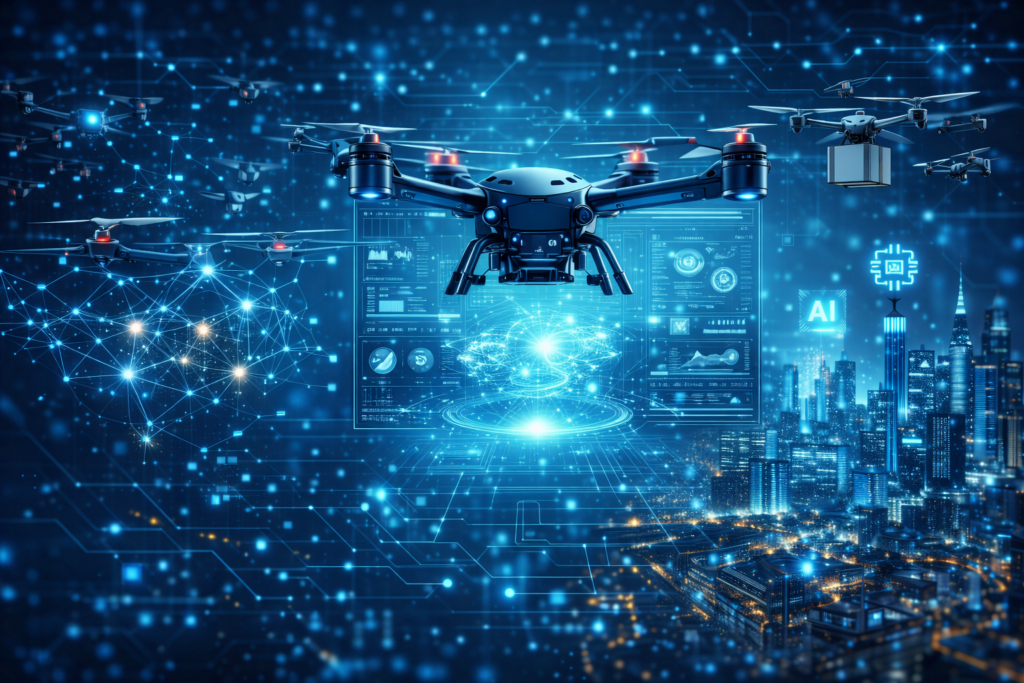
Disclaimer: This image is an AI-generated conceptual illustration created for informational and creative purposes only. It does not represent any real drone system, company, or operational environment. The visuals—including drone swarms, holographic interfaces, and smart city elements—are symbolic representations of emerging drone technologies and future possibilities. Any resemblance to real-world systems or deployments is purely coincidental.
One UI 9: Samsung’s Android 17 Update Rolls Out

One UI 9 is rolling out with Android 17, Galaxy AI upgrades, privacy tools and new features. Here’s the latest Samsung rollout news and device status. Canon EOS R8 Captures Global Attention in 2026 One UI 9: Samsung’s Android 17 Rollout Gathers Pace Samsung’s One UI 9 rollout is entering an important phase. After months…
Canon EOS R8 Captures Global Attention in 2026

Canon EOS R8 gets a major 2026 buying boost as the R8 Mark II arrives. Check its price, specs, 4K video, 40fps shooting and latest firmware. Household Electric Fan: The Quiet Shift to BLDC Cooling The Canon EOS R8 has suddenly become a more interesting camera in 2026, not because Canon has quietly replaced it,…
Household Electric Fan: The Quiet Shift to BLDC Cooling
A household electric fan is getting smarter in 2026, with BLDC motors, battery backup and better efficiency reshaping how Indian homes stay cool. Redmi Note 17 Pro Max: 10,000mAh Battery Changes Game Household Electric Fan: The Quiet Shift to BLDC Cooling The humble household electric fan is going through a surprisingly important transformation. For decades,…




Pingback: ⚛️ Quantum Computing 2026: From Lab Breakthroughs to Cryptography Crisis & Commercial Reality