
Canva’s 2026 updates introduce AI 2.0, offline mode, and new tools. Explore how Canva is transforming design workflows and digital creativity globally.
Figma AI Drives Design Shift in 2026 Creative Era
Introduction: Why Canva Is Dominating the Design Conversation
The latest developments around Canva reveal a company aggressively reshaping the future of digital creativity. Once known as a beginner-friendly design tool, Canva is now positioning itself as a full-scale AI-powered creative operating system.
In 2026, the platform is no longer just competing with traditional tools—it is redefining how design, automation, and collaboration intersect.
Latest News: Canva’s AI 2.0 and Platform Transformation
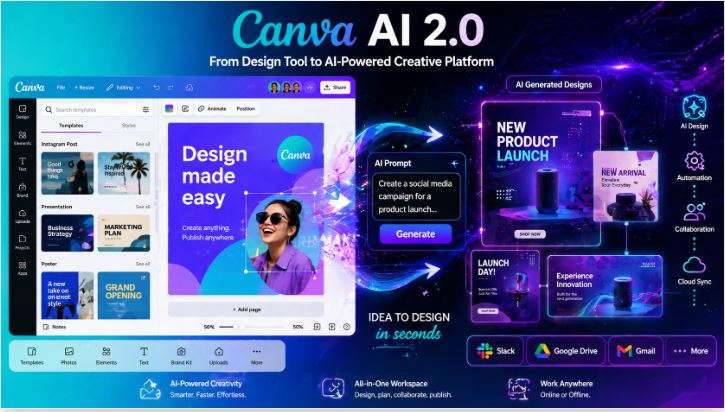
The biggest headline is the launch of Canva AI 2.0, a major overhaul that introduces conversational, prompt-based design workflows. Users can now generate complete campaigns, presentations, or content ecosystems simply by describing what they want.
This update is not incremental. It represents a structural shift toward what the company calls an “AI platform with design tools,” moving beyond its earlier identity as a design tool enhanced by AI.
The platform now integrates deeply with external services like Slack, Gmail, and Google Drive, enabling users to create content directly from their workflows.
The implication is clear: Canva is aiming to become a central workspace where ideation, execution, and publishing happen in one continuous loop.
New Features: Offline Mode, Print Ecosystem, and Learning Tools
At its 2026 product showcase, Canva introduced several long-awaited features that expand its usability across different user segments.
One of the most impactful updates is offline functionality, allowing users to edit designs without internet connectivity and sync later.
The platform also launched:
- A redesigned Print Shop that integrates design and physical product delivery
- Learn Grid, an AI-powered educational resource hub
- An expanded professional design suite with deeper integrations
These updates reflect Canva’s strategy to reduce reliance on multiple tools and bring the entire creative lifecycle under one roof.
Controversy: AI Reliability Under Scrutiny
Despite its rapid innovation, Canva has faced criticism over AI reliability. A recent issue involving its Magic Layers feature unintentionally altered text in user designs, sparking debate around bias and control in generative tools.
The company responded quickly, fixing the issue and promising additional safeguards. However, the incident highlights a broader industry challenge: balancing automation with accuracy and user trust.
Canva’s Evolution Into an AI Platform
Founded in 2012, Canva initially focused on simplifying design for non-professionals. Over time, it expanded into enterprise solutions, education tools, and now AI-driven workflows.
Today, with hundreds of millions of users globally, Canva is transitioning into a creative operating system powered by proprietary AI models designed specifically for visual content creation.
This shift aligns with a wider industry trend where productivity tools are evolving into intelligent, autonomous systems capable of executing complex tasks.
What This Means for Creators and Businesses
The transformation of Canva has several implications:
For creators, the barrier to entry is lowering further. Complex design tasks that once required technical expertise can now be executed through natural language prompts.
For businesses, Canva is becoming a marketing automation engine. It can generate brand-consistent content, schedule campaigns, and even adapt outputs based on previous work patterns.
For the broader industry, Canva’s evolution intensifies competition with established players like Adobe, signaling a shift toward AI-first creative ecosystems.
Conclusion: Canva’s Defining Moment in 2026
The current wave of updates positions Canva at a critical inflection point. It is no longer just democratizing design—it is automating it.
As AI becomes central to creative workflows, Canva’s success will depend on how well it balances innovation with reliability and user control.
If executed effectively, this transition could redefine how individuals and organizations approach design in the coming decade.
Disclaimer: This image is a conceptual and artistic illustration created for editorial and informational purposes only. It is not an official representation of the Canva interface or its actual features. Any UI elements, layouts, or visual depictions shown are stylized interpretations intended to convey the idea of AI-driven design workflows. This image is not affiliated with, endorsed by, or officially connected to Canva or its parent company.
One UI 9: Samsung’s Android 17 Update Rolls Out

One UI 9 is rolling out with Android 17, Galaxy AI upgrades, privacy tools and new features. Here’s the latest Samsung rollout news and device status. Canon EOS R8 Captures Global Attention in 2026 One UI 9: Samsung’s Android 17 Rollout Gathers Pace Samsung’s One UI 9 rollout is entering an important phase. After months…
Canon EOS R8 Captures Global Attention in 2026

Canon EOS R8 gets a major 2026 buying boost as the R8 Mark II arrives. Check its price, specs, 4K video, 40fps shooting and latest firmware. Household Electric Fan: The Quiet Shift to BLDC Cooling The Canon EOS R8 has suddenly become a more interesting camera in 2026, not because Canon has quietly replaced it,…
Household Electric Fan: The Quiet Shift to BLDC Cooling
A household electric fan is getting smarter in 2026, with BLDC motors, battery backup and better efficiency reshaping how Indian homes stay cool. Redmi Note 17 Pro Max: 10,000mAh Battery Changes Game Household Electric Fan: The Quiet Shift to BLDC Cooling The humble household electric fan is going through a surprisingly important transformation. For decades,…





Pingback: Adobe Express AI Leap Transforms Creative Workflows 2026