
Figma AI latest news 2026: features, industry impact, design automation, and how AI is reshaping UI/UX workflows and creative roles globally.
Google VEO Redefines AI Video Creation in 2026 Era
The Rise of Figma AI in Modern Design
Figma has long been a dominant force in collaborative design, but the introduction of Figma AI marks a significant turning point in how digital products are created.
Initially known for real-time collaboration, Figma has evolved into a full-stack design-to-development platform. With AI integration, the platform now supports everything from ideation to code handoff, compressing workflows that traditionally required multiple tools and teams.
By 2026, Figma AI is no longer experimental—it is embedded into everyday workflows for designers, developers, and product teams.
Latest Developments: Figma AI Expands Capabilities in 2026
Recent updates show that Figma AI has expanded far beyond simple automation. The platform now includes capabilities such as content generation, UI drafting, image editing, and even full-site creation from prompts.
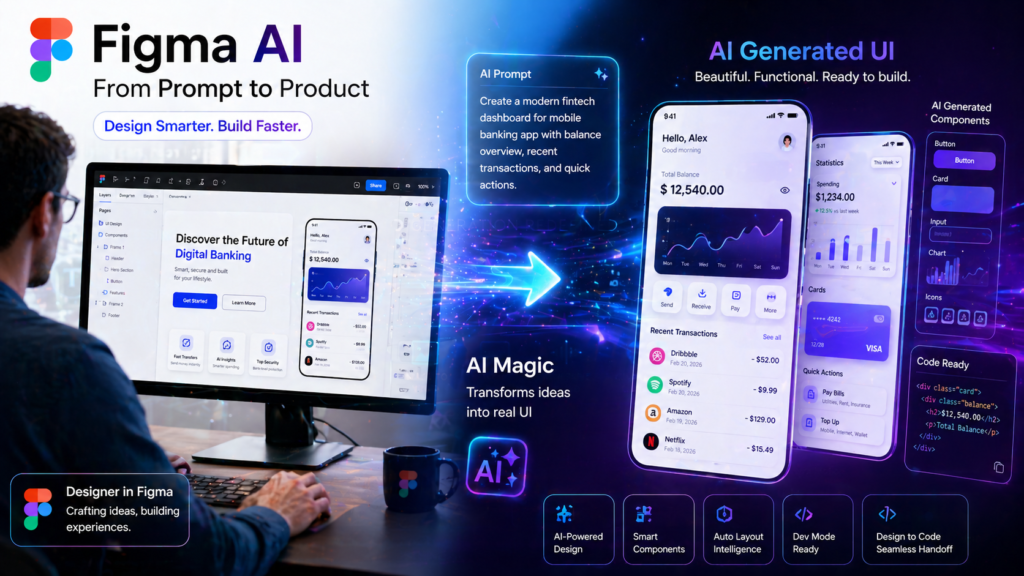
Tools like “First Draft” and “Make” allow users to generate interfaces, interactions, and prototypes directly from natural language instructions. This reflects a broader shift toward prompt-driven design, where creativity begins with intent rather than manual execution.
At the same time, Figma continues to release incremental updates across its ecosystem, including improvements to collaboration tools like FigJam and enhanced design workflows.
Market response has been strong. Investor confidence in Figma’s AI strategy has pushed revenue forecasts higher, with expectations exceeding analyst estimates for 2026.
Technology Deep Dive: What Figma AI Can Do
The strength of Figma AI lies in its integration across the entire product lifecycle.
It enables designers to generate layouts, replace content dynamically, and create images without leaving the design environment. Developers benefit from tools like Dev Mode and Code Connect, which translate designs into production-ready code.
One of the most transformative capabilities is prompt-to-product workflows. Using tools like Figma Make, teams can move from an idea to a functional prototype in a single environment, significantly reducing iteration cycles.
This convergence of design and engineering is redefining how digital products are built.
Industry Debate: Will AI Replace Designers?
The rise of Figma AI has sparked an intense debate within the design community.
Some industry voices suggest that AI could reduce the need for traditional design roles, as non-designers gain access to powerful creative tools.
However, many experts argue that AI enhances rather than replaces human creativity. While automation can handle repetitive tasks, design still requires empathy, strategic thinking, and user understanding—areas where human input remains critical.
Figma’s own research supports this view. A majority of designers report working faster and producing better outcomes with AI, indicating that the technology is augmenting rather than diminishing their role.
Competitive Landscape: Pressure from AI Rivals
Figma AI is not evolving in isolation. Competitors are rapidly entering the space with their own AI-driven design tools.
New platforms are introducing concepts like “vibe designing,” where users describe the emotional tone or purpose of a product and AI generates complete interfaces.
Similarly, emerging tools like Anthropic’s AI design systems are lowering the barrier to entry for non-designers, intensifying competition in the market.
Despite this, Figma’s strength lies in its ecosystem. By integrating AI directly into an established workflow used by millions, it maintains a significant advantage over standalone tools.
Practical Impact: How Teams Are Using Figma AI
Across industries, teams are adopting Figma AI to accelerate product development.
Designers are using AI to generate multiple layout variations instantly. Product managers are prototyping ideas without writing code. Developers are receiving cleaner, more structured design handoffs.
This shift is particularly visible in startups and agile teams, where speed and iteration are critical. AI allows these teams to experiment more freely, validate ideas faster, and reduce time-to-market.
The broader implication is clear: design is becoming more accessible, collaborative, and data-driven.
What Lies Ahead for Figma AI
Looking forward, Figma AI is expected to evolve into a more autonomous design system.
Future developments may include deeper integration with AI agents, enhanced real-time collaboration between humans and machines, and more advanced simulation of user interactions.
At the same time, challenges remain. Balancing automation with creative control, addressing ethical concerns, and maintaining design quality will be critical as AI becomes more embedded in workflows.
Figma’s trajectory suggests that the future of design will not be about replacing humans, but about redefining their role alongside intelligent systems.
Disclaimer : This image is a conceptual and illustrative representation created for informational and editorial purposes only. It is not an official interface, product screenshot, or endorsed visual of Figma or its AI features referred to as Figma AI. All UI elements, prompts, code snippets, and design layouts shown are artistic interpretations meant to demonstrate how AI-assisted design workflows might appear. They do not reflect actual product functionality, availability, or user experience. Any resemblance to real interfaces, tools, or proprietary systems is coincidental. For accurate and official information, refer to announcements and documentation from Figma.
One UI 9: Samsung’s Android 17 Update Rolls Out

One UI 9 is rolling out with Android 17, Galaxy AI upgrades, privacy tools and new features. Here’s the latest Samsung rollout news and device status. Canon EOS R8 Captures Global Attention in 2026 One UI 9: Samsung’s Android 17 Rollout Gathers Pace Samsung’s One UI 9 rollout is entering an important phase. After months…
Canon EOS R8 Captures Global Attention in 2026

Canon EOS R8 gets a major 2026 buying boost as the R8 Mark II arrives. Check its price, specs, 4K video, 40fps shooting and latest firmware. Household Electric Fan: The Quiet Shift to BLDC Cooling The Canon EOS R8 has suddenly become a more interesting camera in 2026, not because Canon has quietly replaced it,…
Household Electric Fan: The Quiet Shift to BLDC Cooling
A household electric fan is getting smarter in 2026, with BLDC motors, battery backup and better efficiency reshaping how Indian homes stay cool. Redmi Note 17 Pro Max: 10,000mAh Battery Changes Game Household Electric Fan: The Quiet Shift to BLDC Cooling The humble household electric fan is going through a surprisingly important transformation. For decades,…




Pingback: Canva AI Shift Redefines Design Ecosystem in 2026