
Discover the latest Edge computing trends, including AI integration, 5G acceleration, real-time processing, enterprise adoption driving the next digital wave.
Videoconferencing 2026: AI, Security & Hybrid Work
🧠 Edge computing
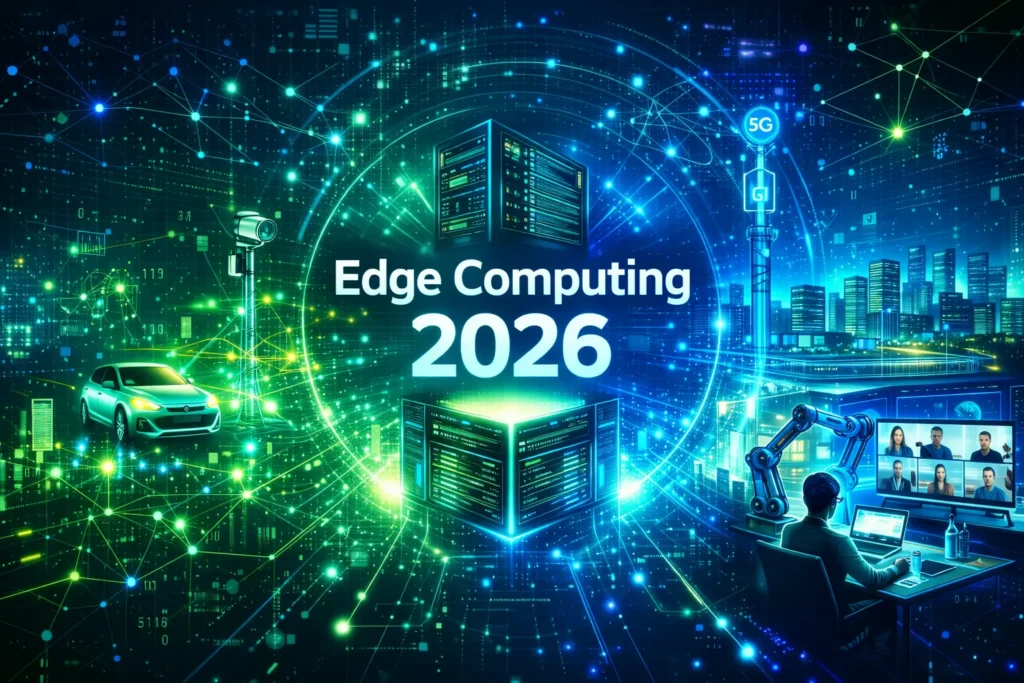
Edge computing is a distributed computing model that processes data closer to its source—such as IoT devices, sensors, and local servers—rather than relying solely on centralized cloud infrastructure. This approach significantly reduces latency, enhances performance, and improves data privacy.
By 2026, edge computing has evolved into a core enterprise technology, enabling real-time decision-making across industries like healthcare, manufacturing, logistics, and smart cities.
📰 Latest Edge Computing News & Trends (2026)
1. 🤖 Edge AI Becomes Mainstream
Artificial Intelligence is rapidly shifting from cloud data centers to edge devices:
- AI inference is now performed locally on devices
- Faster decision-making without cloud delays
- Reduced bandwidth usage and improved privacy
Edge AI is now considered operational infrastructure, not experimental technology.
2. ⚡ 5G & Next-Gen Connectivity Boost Edge Growth
The rollout of advanced 5G networks is accelerating edge computing adoption:
- Ultra-low latency enables real-time automation
- Supports billions of connected IoT devices
- Powers applications like autonomous vehicles and AR/VR
This synergy between edge computing and 5G is unlocking new digital capabilities across industries.
3. 🏙️ Smart Cities & Real-Time Infrastructure
Edge computing is becoming foundational for smart city development:
- Traffic systems adapt in real time
- Surveillance and public safety improve instantly
- Energy grids optimize dynamically
Processing data locally enables faster responses compared to traditional cloud-based systems.
4. 🔐 Security Evolves with Zero-Trust Models
As edge devices expand, security frameworks are evolving:
- Zero-trust architectures validate every interaction
- AI-driven threat detection at device level
- Hardware-based encryption enhances protection
Security at the edge is shifting from reactive to predictive defense systems.
5. 🏭 Enterprise Adoption & Industry Transformation
Edge computing is transforming industries:
- Manufacturing uses real-time automation and robotics
- Retail leverages predictive analytics and smart inventory
- Healthcare enables instant patient monitoring
Enterprises are moving toward edge-native applications designed for local-first execution.
6. 📈 Market Growth & Investment Surge
The edge computing market is expanding rapidly:
- Estimated at $28.5 billion in 2026
- Projected to reach over $263 billion by 2035
- CAGR of approximately 28%
This growth highlights strong enterprise demand and future scalability.
7. 🌐 Hybrid Cloud + Edge Architecture
The future is not cloud vs edge—but both working together:
- Simple tasks handled at the edge
- Complex processing remains in the cloud
- Hybrid architectures optimize performance and cost
This distributed model is becoming the standard IT architecture in 2026.
📊 Industry Outlook
Edge computing is expected to define the next generation of digital infrastructure:
- Enables real-time digital experiences
- Supports AI-driven automation at scale
- Reduces dependency on centralized data centers
- Enhances privacy and compliance
Experts predict edge computing will be a key driver of tech innovation and competitive advantage in the coming years.
🧩 Key Takeaways
- Edge computing is now a core enterprise technology
- AI and edge integration is transforming real-time decision-making
- 5G is accelerating adoption across industries
- Security is evolving with zero-trust and AI-based protection
- Hybrid cloud-edge architecture is the future
Disclaimer : The information provided in this article is for general informational and educational purposes only and should not be considered professional, technical, or business advice. While every effort has been made to ensure the accuracy of the content, developments in edge computing technologies and market trends may change rapidly. Readers are encouraged to conduct their own research and consult with qualified professionals before making decisions related to technology implementation, investments, or business strategies. The author and publisher are not responsible for any losses or damages resulting from the use of this information. All opinions expressed are based on current industry insights and are subject to change without notice.
-
Preemptive Cybersecurity 2026: Stop Threats Before They Strike

Preemptive Cybersecurity is transforming digital defense by predicting, preventing cyberattacks before they happen. Explore trends, strategies, future insights. Physical AI: The Next Frontier of Intelligent Machines Introduction: The Shift to Preemptive Cybersecurity Cybersecurity in 2026 is undergoing a fundamental shift—from reactive defense to proactive, predictive protection. Known as Preemptive Cybersecurity, this approach focuses on stopping…
-
Physical AI: The Next Frontier of Intelligent Machines
Physical AI is revolutionizing 2026 by enabling machines to interact with the real world through robotics, sensors, and autonomous decision-making systems. Domain-Specific Language Models Transform AI in 2026 🚀 The Rise of Physical AI The AI revolution is no longer confined to screens and software. In 2026, Physical AI is emerging as the next major…
-
Domain-Specific Language Models Transform AI in 2026
Domain-Specific Language Models are redefining AI in 2026 with higher accuracy, lower costs, and industry-focused intelligence for enterprise applications. Multiagent Systems: Powering Autonomous AI in 2026 🚀 The Rise of Domain-Specific Language Models In 2026, the AI landscape is undergoing a decisive shift—from massive general-purpose models to Domain-Specific Language Models (DSLMs). These specialized AI systems…