
German 19th-Century Brass Calculator attracts renewed attention as collectors, historians, and museums highlight the origins of mechanical computing.
Aurumania Crystal Edition Gold Bike Still Defines Luxury
German 19th-Century Brass Calculator Gains New Spotlight
The German 19th-Century Brass Calculator is experiencing a remarkable resurgence in global attention as collectors, historians, museums, and technology enthusiasts increasingly recognize the importance of early mechanical computing devices. While modern society relies on smartphones, artificial intelligence, and advanced computing systems, interest is growing in the machines that laid the foundations for today’s digital world.
Recent discussions within the antiques and scientific heritage sectors have focused on the preservation, valuation, and historical significance of rare calculating machines. High-profile auction activity involving early calculators has reignited public fascination with mechanical computation and the inventors who transformed mathematics from a manual process into a machine-assisted discipline.
For many experts, the renewed attention surrounding antique calculators is about more than collecting valuable artifacts. It represents a broader effort to understand how modern computing evolved from intricate brass mechanisms developed during the Industrial Revolution.
Why Antique Calculators Are Making Headlines Again
Interest in historical calculating machines has increased significantly following recent debates surrounding the sale and preservation of some of the world’s earliest mechanical calculators. Museums, academics, and collectors have argued that these devices should be viewed as technological treasures that helped shape the development of modern computing.
As discussions continue about the ownership and preservation of historic calculating machines, attention has naturally expanded to include German 19th-century brass calculators, which represent some of the most advanced computational devices of their era.
Many specialists consider these instruments to be critical milestones in engineering history because they demonstrate how complex mathematical operations could be performed mechanically long before electronic computers existed.
Engineering Precision Before the Digital Age
The German 19th-Century Brass Calculator reflects a period when precision engineering and scientific innovation were advancing rapidly across Europe. Crafted primarily from brass, steel, and finely machined components, these calculators were designed to perform arithmetic calculations with impressive accuracy.
Inventors and manufacturers in Germany played an important role in improving mechanical calculation technologies throughout the nineteenth century. Their work influenced future generations of adding machines, business calculators, and eventually electronic computing devices.
The intricate gears, dials, levers, and rotating mechanisms found in these calculators reveal a remarkable level of craftsmanship that continues to impress historians and engineers alike.
A Growing Market for Computing Heritage
The market for antique scientific instruments has remained resilient despite broader fluctuations in the collectibles industry. Rare mechanical calculators, particularly those connected to significant technological milestones, have attracted increasing attention from museums and private collectors.
Experts note that historic calculating machines are increasingly viewed as artifacts of computing history rather than simple antiques. This shift in perception has contributed to stronger demand and growing efforts to preserve surviving examples.
Recent auction-related headlines involving historic calculators have further highlighted the cultural and monetary value attached to early computational devices. These developments have encouraged renewed research into lesser-known machines, including German-made brass calculators from the nineteenth century.
The Link Between Mechanical Calculators and Modern Technology
One reason for the renewed fascination with antique calculators is their direct connection to modern technology. The fundamental goal behind nineteenth-century calculating machines was to automate repetitive mathematical tasks, a principle that remains central to modern computing.
Although today’s processors perform billions of calculations per second, the conceptual foundation can be traced back to the mechanical innovations developed by inventors more than a century ago.
The German 19th-Century Brass Calculator serves as a tangible reminder of how technological progress often begins with seemingly simple inventions that gradually evolve into transformative innovations.
Preserving an Important Chapter of Computing History
Museums and academic institutions continue to emphasize the importance of preserving early calculating machines. These devices offer valuable insights into the history of mathematics, engineering, manufacturing, and information technology.
As interest in computing heritage expands, experts believe that nineteenth-century calculators will become increasingly important educational tools. They provide a unique opportunity to demonstrate how mechanical systems solved complex problems long before the arrival of digital electronics.
For historians, collectors, and technology enthusiasts, the German 19th-Century Brass Calculator represents far more than an antique object. It is a symbol of human ingenuity and an essential chapter in the story of technological progress.
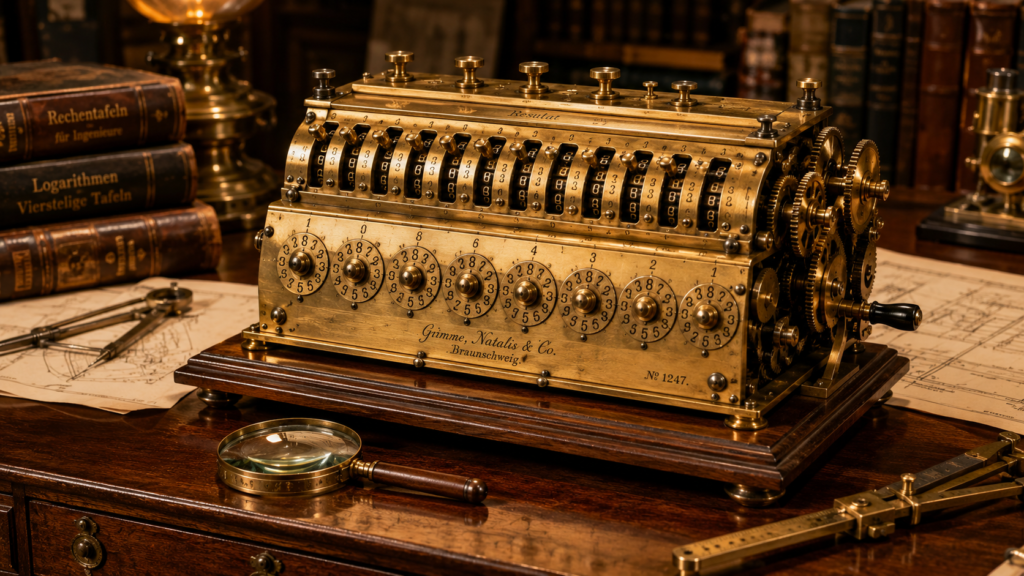
German 19th-Century Brass Calculator
German mechanical calculators emerged during a period of rapid industrial and scientific advancement across Europe. Many were constructed from brass due to its durability, machinability, and resistance to corrosion. These devices were used by engineers, scientists, businesses, and government institutions to perform calculations more efficiently than manual methods allowed.
Their development contributed to a broader movement toward automation and precision engineering that eventually influenced the creation of modern business machines and electronic computers.
Disclaimer: This image is a conceptual editorial illustration created for educational, historical, and visual presentation purposes. It is not an authentic photograph of a specific German 19th-century brass calculator, museum artifact, or privately owned collection piece. The calculator design, engravings, mechanical details, surrounding objects, and study environment may have been artistically interpreted or enhanced to represent the technological style and craftsmanship of nineteenth-century mechanical calculating devices. Any resemblance to actual historical instruments, manufacturers, museums, or collections is coincidental. This image is intended to illustrate the evolution of mechanical computation and the history of scientific instrumentation.
Canon EOS R8 Captures Global Attention in 2026

Canon EOS R8 gets a major 2026 buying boost as the R8 Mark II arrives. Check its price, specs, 4K video, 40fps shooting and latest firmware. Household Electric Fan: The Quiet Shift to BLDC Cooling The Canon EOS R8 has suddenly become a more interesting camera in 2026, not because Canon has quietly replaced it,…
Household Electric Fan: The Quiet Shift to BLDC Cooling

A household electric fan is getting smarter in 2026, with BLDC motors, battery backup and better efficiency reshaping how Indian homes stay cool. Redmi Note 17 Pro Max: 10,000mAh Battery Changes Game Household Electric Fan: The Quiet Shift to BLDC Cooling The humble household electric fan is going through a surprisingly important transformation. For decades,…
Redmi Note 17 Pro Max: 10,000mAh Battery Changes Game
Redmi Note 17 Pro Max brings a 10,000mAh battery, 100W charging, 120Hz AMOLED and Snapdragon 6 Gen 5. India launch is tipped for September 15, 2026 Price is key Lattice-Based Cryptography: The Quantum-Safe Race Xiaomi Redmi Note 17 Pro Max is now official, but India is the real test The xiaomi redmi note 17 pro…