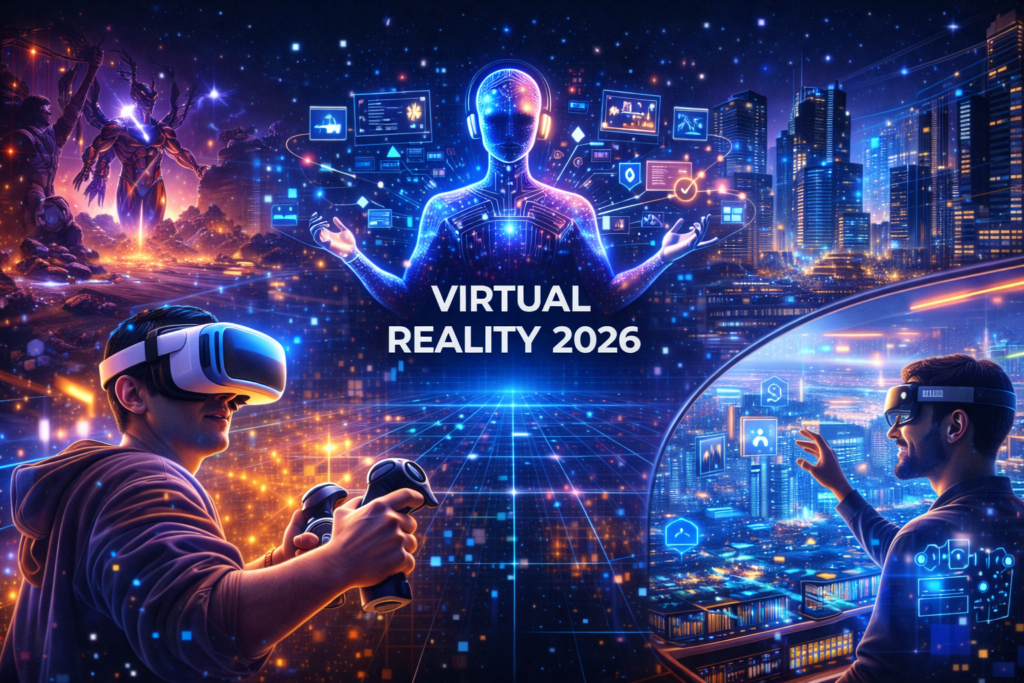
Explore how Virtual reality is evolving in 2026 with AI integration, enterprise adoption, industry setbacks, and the shift toward mixed reality experiences.
RFID in 2026: From Invisible Tags to Intelligent Infrastructure Powering the Data Economy
📌 Introduction: Virtual Reality at a Crossroads
The Virtual reality industry in 2026 is experiencing a paradoxical moment—rapid technological advancement alongside strategic industry recalibration.
While VR continues to expand into enterprise, defense, and immersive entertainment, major tech players are rethinking the metaverse-first approach, signaling a more pragmatic and diversified future.
📰 Breaking News: Growth Meets Reality Check
Recent developments reveal a mixed trajectory:
🚀 Expansion & Innovation
- VR is being used for military training simulations, enabling cost-effective and repeatable training environments
- Immersive VR experiences like historical simulations and exhibitions are gaining global popularity
- VR gaming continues to grow with new releases and showcase events highlighting innovation
⚠️ Industry Challenges
- Major platforms are scaling back VR-focused metaverse investments and shifting toward mobile and AI
- VR social platforms are shutting down due to sustainability issues
- Billions in losses have forced companies to restructure VR divisions
👉 The takeaway: Virtual reality is evolving—but not in the way originally predicted
🤖 AI + Virtual Reality: The Next Evolution Layer
Artificial intelligence is now deeply integrated into Virtual reality systems:
Key Innovations:
- Real-time gesture recognition enabling controller-free interaction
- AI-driven avatars and facial expression tracking enhancing realism
- Smart simulations for training, education, and industrial use
👉 VR is shifting from visual immersion → intelligent interaction
🎮 VR Gaming & Entertainment: Still the Core Driver
Gaming remains the strongest pillar of Virtual reality:
- Major VR showcases in 2026 reveal new immersive titles and experiences
- Location-based VR experiences are attracting mass audiences
- Social VR platforms like VRChat continue to maintain active communities
However, the closure of some VR platforms signals that monetization and user retention remain challenges.
🏭 Enterprise & Industrial Use Cases
Beyond gaming, Virtual reality is expanding into serious applications:
Key Sectors:
- Defense and military training
- Healthcare simulations and therapy
- Manufacturing and workforce training
- Environmental modeling and urban planning
👉 VR is becoming a business-critical technology, not just entertainment
📊 Market Trends & Strategic Shift
The VR industry is undergoing a strategic transition:
Key Trends:
- Shift from VR-only → Mixed Reality (MR) & Augmented Reality (AR)
- Focus on practical applications over hype-driven metaverse visions
- Integration with AI, cloud computing, and 6G networks
Companies are prioritizing:
- Accessibility (mobile + lightweight devices)
- Real-world utility
- Cost efficiency
👉 The industry is entering a “post-hype, value-driven phase”
⚖️ Challenges Facing Virtual Reality
Despite innovation, VR faces several hurdles:
- High hardware costs limiting mass adoption
- Motion sickness and usability concerns
- Content ecosystem fragmentation
- Security vulnerabilities in immersive systems
👉 These challenges must be solved for VR to achieve mainstream dominance
🌍Evolution of Virtual Reality
- 1990s–2000s: Experimental VR systems
- 2010s: Consumer VR (Oculus, HTC Vive)
- Early 2020s: Metaverse boom
- Mid-2020s: Industry correction + AI integration
👉 2026 marks the transition into the “practical immersive computing era”
🚀 Future Outlook: What’s Next for Virtual Reality?
The future of Virtual reality will likely include:
- Lightweight, wearable VR/AR devices
- AI-powered immersive environments
- Cloud-based VR streaming
- Cross-platform mixed reality ecosystems
Experts suggest VR will evolve into a core layer of spatial computing, blending seamlessly with daily life.
Disclaimer: This content is intended for informational and illustrative purposes only. The image is a conceptual representation of future trends in Virtual reality technology and does not depict any real product, platform, or proprietary system. Any resemblance to actual brands, devices, or technologies is purely coincidental. All trademarks, logos, and brand names remain the property of their respective owners. No endorsement or affiliation with any company or organization is implied.
-
Preemptive Cybersecurity 2026: Stop Threats Before They Strike

Preemptive Cybersecurity is transforming digital defense by predicting, preventing cyberattacks before they happen. Explore trends, strategies, future insights. Physical AI: The Next Frontier of Intelligent Machines Introduction: The Shift to Preemptive Cybersecurity Cybersecurity in 2026 is undergoing a fundamental shift—from reactive defense to proactive, predictive protection. Known as Preemptive Cybersecurity, this approach focuses on stopping…
-
Physical AI: The Next Frontier of Intelligent Machines
Physical AI is revolutionizing 2026 by enabling machines to interact with the real world through robotics, sensors, and autonomous decision-making systems. Domain-Specific Language Models Transform AI in 2026 🚀 The Rise of Physical AI The AI revolution is no longer confined to screens and software. In 2026, Physical AI is emerging as the next major…
-
Domain-Specific Language Models Transform AI in 2026
Domain-Specific Language Models are redefining AI in 2026 with higher accuracy, lower costs, and industry-focused intelligence for enterprise applications. Multiagent Systems: Powering Autonomous AI in 2026 🚀 The Rise of Domain-Specific Language Models In 2026, the AI landscape is undergoing a decisive shift—from massive general-purpose models to Domain-Specific Language Models (DSLMs). These specialized AI systems…