
Explore how Autonomous vehicles are evolving in 2026 with AI breakthroughs, robotaxis, safety challenges, and global expansion shaping the future of mobility.
Apps in 2026: AI Agents, Super Apps & the End of Traditional Mobile Experiences?
Introduction: The Autonomous Vehicles Turning Point
The Autonomous vehicles industry in 2026 is at a critical inflection point. While technological breakthroughs are accelerating deployment, real-world incidents and regulatory scrutiny are exposing the complexity of achieving fully driverless mobility.
From robotaxi expansion to AI-powered driving systems, Autonomous vehicles are transitioning from experimental technology to commercial reality—yet not without friction.
Breaking News: Progress vs Problems
Recent developments reveal a dual narrative:
Rapid Progress
- Autonomous robotaxis are scaling globally, including fully driverless deployments in cities like Dubai
- Companies like Waymo are expanding to hundreds of thousands of weekly rides and targeting personal vehicle integration
- AI-powered vehicles are demonstrating strong real-world driving performance in urban environments
Major Concerns
- A large-scale robotaxi outage in China left passengers stranded, highlighting reliability risks
- Governments are demanding transparency around remote human intervention in self-driving systems
- Safety incidents continue to influence public trust and regulatory response
The takeaway: Autonomous vehicles are advancing fast—but not smoothly
AI & Technology Driving Autonomous Vehicles
The backbone of Autonomous vehicles is advanced artificial intelligence and sensor fusion:
- Multi-sensor systems (LiDAR, radar, cameras) enabling 360° perception
- AI models trained on massive real-world and simulated datasets
- Real-time decision-making powered by next-gen chips
At CES 2026, autonomous driving re-emerged as a dominant theme, driven by AI breakthroughs and scalable data ecosystems
Additionally, new hardware platforms are accelerating performance:
- NVIDIA’s next-gen chips delivering massive compute improvements
- Increasing integration of robotics and autonomous mobility systems
Autonomous vehicles are essentially AI systems on wheels
Robotaxi Boom: The New Mobility Model
Robotaxis are leading commercialization:
- Waymo expanding fleets and entering new cities
- Baidu scaling aggressively in China
- Uber partnerships enabling global rollout
The robotaxi market is projected to grow at an extraordinary pace:
- Estimated 90% CAGR from 2025–2030
However, incidents like system outages show the risks of centralized control and connectivity dependence.
Regulation & Safety: The Biggest Roadblocks
Regulation remains one of the biggest challenges:
- Governments demanding greater transparency and accountability
- Concerns about remote operators controlling vehicles
- Delays in policy frameworks slowing adoption in some regions
Even in advanced markets, policymakers are struggling to keep pace with innovation.
The industry faces a key dilemma:
Move fast and risk safety—or slow down and lose innovation momentum
Market Growth & Business Impact
Despite challenges, the Autonomous vehicles market is expanding rapidly:
- Expected to reach $62 billion in 2026
- Passenger vehicle revenue projected at $300–400 billion by 2035
Key business shifts:
- Transition from R&D → commercialization
- Intellectual property becoming a competitive advantage
- Partnerships between tech companies and automakers increasing
Evolution of Autonomous Vehicles
Understanding today’s landscape:
- 2010s: Early prototypes and testing
- Early 2020s: Pilot deployments and hype
- Mid-2020s: Reality check + gradual rollout
Interestingly, industry expectations have shifted:
- Fully autonomous (Level 4/5) adoption delayed
- Focus now on Level 2+ and incremental automation
We are entering a “practical autonomy era”, not full autonomy yet.
Future Outlook: What’s Next?
The future of Autonomous vehicles will likely include:
- Hybrid models combining AI + human oversight
- Expansion into personal autonomous cars
- Integration with smart cities and IoT infrastructure
- Growth of autonomous logistics and trucking
Some companies are even exploring fully driverless personal vehicles, signaling the next phase of adoption.
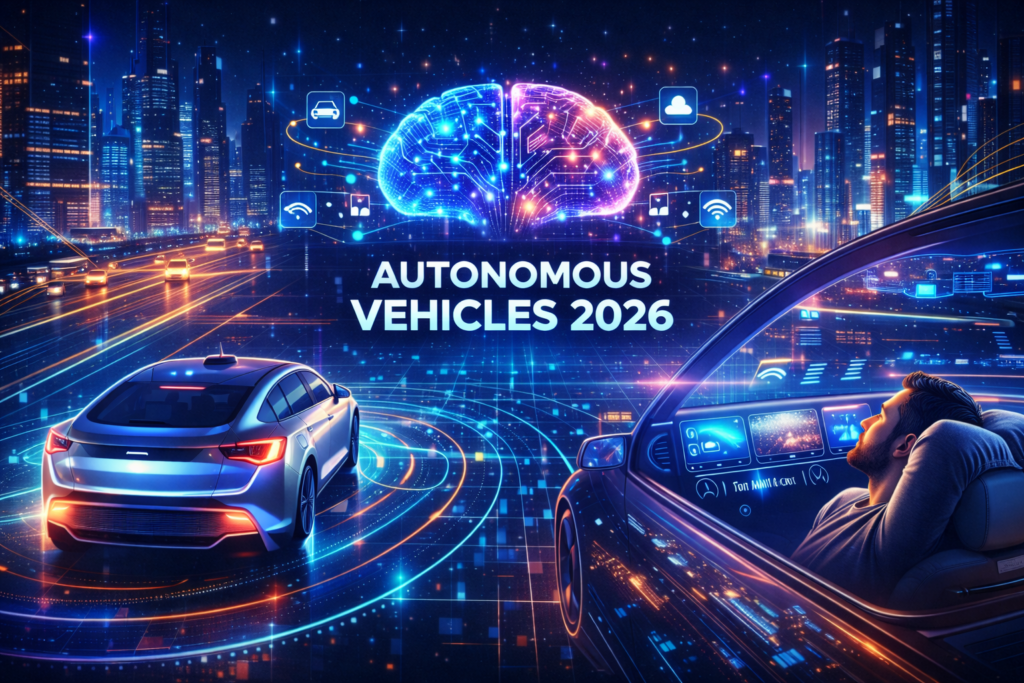
Disclaimer: This content is created for informational and illustrative purposes only. The visual representation is a conceptual design intended to depict trends and innovations in Autonomous vehicles. Any resemblance to real vehicles, brands, technologies, or interfaces is purely coincidental. All trademarks, brand names, and logos belong to their respective owners. This image does not represent any official product, endorsement, or partnership with any automotive or technology company.
One UI 9: Samsung’s Android 17 Update Rolls Out

One UI 9 is rolling out with Android 17, Galaxy AI upgrades, privacy tools and new features. Here’s the latest Samsung rollout news and device status. Canon EOS R8 Captures Global Attention in 2026 One UI 9: Samsung’s Android 17 Rollout Gathers Pace Samsung’s One UI 9 rollout is entering an important phase. After months…
Canon EOS R8 Captures Global Attention in 2026

Canon EOS R8 gets a major 2026 buying boost as the R8 Mark II arrives. Check its price, specs, 4K video, 40fps shooting and latest firmware. Household Electric Fan: The Quiet Shift to BLDC Cooling The Canon EOS R8 has suddenly become a more interesting camera in 2026, not because Canon has quietly replaced it,…
Household Electric Fan: The Quiet Shift to BLDC Cooling
A household electric fan is getting smarter in 2026, with BLDC motors, battery backup and better efficiency reshaping how Indian homes stay cool. Redmi Note 17 Pro Max: 10,000mAh Battery Changes Game Household Electric Fan: The Quiet Shift to BLDC Cooling The humble household electric fan is going through a surprisingly important transformation. For decades,…





Pingback: 📡 RFID in 2026: From Invisible Tags to Intelligent Infrastructure Powering the Data Economy